
Six paths. One cumulative question.
An inquiry into faith, revelation, and the Qurʾan, organized as six convergent lines of investigation — each developed with the rigor of academic philosophy of religion.
ACT ONE · THE QUESTION
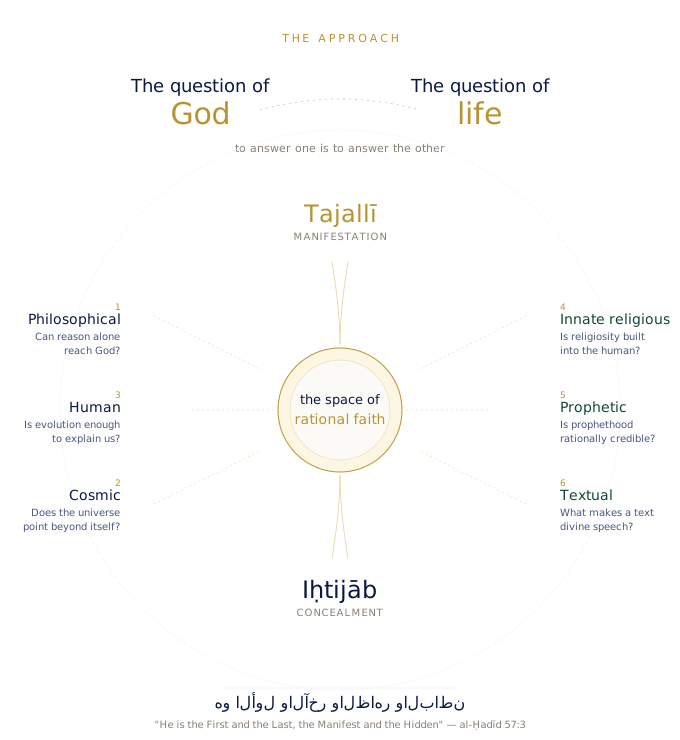
Two questions, one horizon
God Database addresses the question of God. But this question is not isolated — it is the doorway to the wider question of the reality of life itself. To ask whether God exists is also to ask what the world is, where we come from, where we are going, and whether life has direction.
If God exists, life has origin, meaning, and finality grounded in something that transcends it. If God does not exist, life is what naturalism describes — and that, too, is an answer to the question of life. To answer one is to answer the other.
Between divine manifestation (tajallī) and divine concealment (iḥtijāb) opens the space where rational faith becomes possible: a space where reason can investigate, where evidence can accumulate, where neither blind belief nor confident denial does justice to what we encounter.
ACT TWO · THE METHOD
Six convergent paths
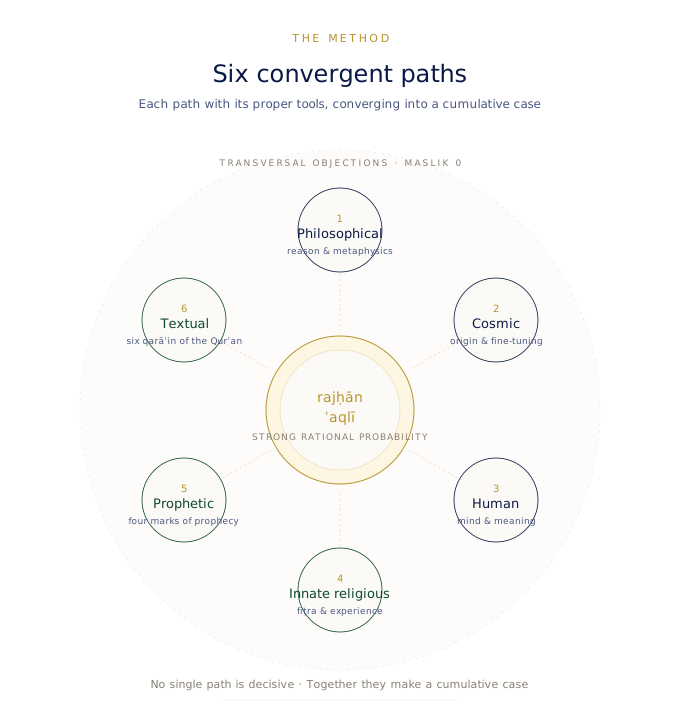
No single argument settles the question of God. The framework presents six distinct paths of investigation — each with its own methods, its own evidence, its own internal debates. Some belong to natural reason; some belong to the religious and prophetic phenomena. None is decisive alone.
Together, they constitute a cumulative case: not a chain of proofs in which each link must hold, but a convergence of independent lines of evidence each pointing in the same direction. This is how rational confidence forms in most complex domains — history, science of complex systems, even ordinary practical judgment. We call the resulting epistemic state rajḥān ʿaqlī — strong rational probability.
A seventh dimension, transversal, holds the great objections that cross every path: the problem of evil, divine hiddenness, religious plurality, religion and violence, faith and doubt. These belong to no single pathway because they belong to all.
Philosophical
Can reason alone reach God?
Read articles →
2Cosmic
Does the universe point beyond itself?
Read articles →
3Human
Is evolution enough to explain us?
Read articles →
4Innate religious
Is religiosity built into the human?
Read articles →
5Prophetic
Is prophethood rationally credible?
Read articles →
6Textual
What makes a text divine speech?
Read articles →
ACT THREE · THE TEXTUAL TEST
What if a text claims divine speech?
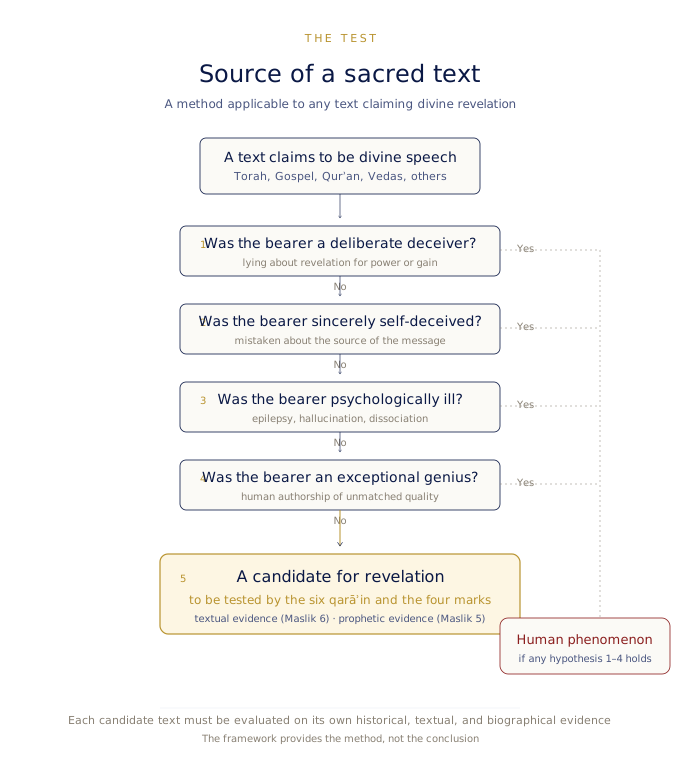
Several traditions claim to possess sacred texts revealed by God — the Torah, the Gospels, the Qurʾan, the Vedas, and others. Each such claim invites the same methodological question: what would distinguish a genuinely revealed text from a brilliant human production?
The framework offers a generic decision procedure. Five hypotheses are examined in turn: was the bearer a deliberate deceiver? a sincere but self-deceived enthusiast? psychologically ill? an exceptional human genius? If all four can be rejected on the available evidence, the text remains a candidate for revelation — to be then evaluated by the six textual qarāʾin and the four marks of prophecy.
The framework provides the method, not the conclusion. Each candidate text — Torah, Gospel, Qurʾan, Vedas — must be evaluated on its own historical, textual, and biographical evidence. The framework’s position is that the Qurʾan satisfies this test robustly, but this is the result of applying the method, not a premise.
Start exploring
Eighty research-grade articles trace these six paths across philosophy, cosmology, anthropology, religious science, and Qurʾanic studies.