
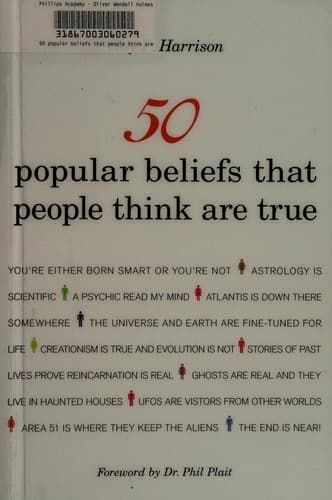
50 Popular Beliefs That People Think Are True
50 معتقداً شائعاً يظن الناس أنها صحيحة
50 Croyances Populaires que les Gens Pensent Vraies
Editorial summary
Guy P. Harrison's "50 Popular Beliefs That People Think Are True" examines widespread misconceptions across multiple domains of human belief, including religious, paranormal, and pseudoscientific claims. The work serves as a skeptical investigation into commonly held assumptions that persist despite lacking empirical support, positioning itself within the broader tradition of scientific skepticism and critical thinking advocacy.
Harrison structures his analysis around fifty distinct beliefs, dedicating each chapter to dismantling a specific claim through evidence-based reasoning and scientific methodology. While the book addresses diverse topics ranging from UFOs to alternative medicine, several chapters directly engage with religious and theistic claims, including beliefs about prayer, miracles, and divine intervention. The author employs a conversational yet rigorous approach, combining accessible explanations with substantive references to scientific research and logical analysis.
The work's contribution to the God debate emerges through its systematic application of skeptical inquiry to religious claims. Harrison does not single out theistic beliefs for special criticism but rather treats them as part of a broader category of unsubstantiated claims that merit scrutiny. His methodology emphasizes the importance of evidence, falsifiability, and rational evaluation when assessing any belief system, religious or otherwise. This approach aligns with the naturalistic worldview that underlies much contemporary atheistic thought, though Harrison focuses more on promoting critical thinking skills than advocating for any particular metaphysical position.
Harrison's intellectual framework draws from the tradition of popular science writing and skeptical activism associated with figures like Carl Sagan, James Randi, and Michael Shermer. The work functions as both an educational resource and a practical guide for developing skeptical thinking skills. By addressing religious beliefs alongside other popular misconceptions, Harrison implicitly argues that supernatural claims should be subject to the same evidential standards as any other empirical assertion.
The book's significance to discussions about God lies in its democratization of skeptical methodology. Rather than engaging in abstract philosophical arguments about theism, Harrison provides readers with practical tools for evaluating religious claims in everyday contexts. This approach makes the work particularly relevant for understanding how skeptical attitudes toward religious belief develop and spread in contemporary culture. The text serves as an entry point for general readers into the broader skeptical movement's critique of supernatural beliefs, including traditional theistic claims.
Argument formulations engaged
Related works
Harrison, Guy P. (2012). 50 Popular Beliefs That People Think Are True. Prometheus Books.
@book{50-popular-beliefs-that-people-think-are,
  author    = {Harrison, Guy P.},
  title     = {50 Popular Beliefs That People Think Are True},
  year      = {2012},
  publisher = {Prometheus Books},
  url       = {https://god-database.com/en/works/50-popular-beliefs-that-people-think-are-true-2012}
}