
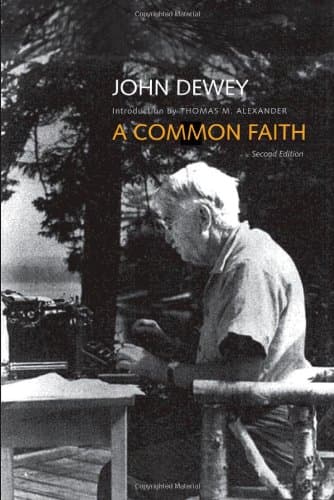
A Common Faith
إيمان مشترك
Une foi commune
Editorial summary
John Dewey's "A Common Faith" presents a naturalistic reconstruction of religious experience that divorces the religious quality of human life from supernatural beliefs and institutional religion. Writing during the Depression era when traditional faiths faced mounting skepticism, Dewey attempts to preserve what he considers valuable in religious experience while rejecting theistic metaphysics and organized religion's claims to exclusive truth.
The work develops through three interconnected arguments. First, Dewey distinguishes between "religion" as a noun—denoting specific creeds, institutions, and supernatural beliefs—and "religious" as an adjective, describing a quality of experience available through purely natural means. This religious quality emerges when individuals achieve harmonious adjustment between themselves and the conditions of existence, producing attitudes of reverence, piety, and commitment without requiring belief in supernatural entities.
Second, Dewey reconceptualizes faith as active commitment to ideal ends rather than intellectual assent to doctrines. He argues that ideals arise from imagination's projection of possible goods based on actual experience, not from divine revelation. This naturalistic faith directs itself toward human flourishing and social progress, finding its objects in democracy, scientific inquiry, and moral community rather than transcendent beings.
Third, Dewey redefines the divine as the active relation between ideal and actual, the process through which human intelligence and effort transform existing conditions toward envisioned goods. God becomes not a supernatural person but the unity of idealizing imagination with active forces in nature and society that support human aspiration.
The monograph explicitly challenges both traditional theism and militant atheism. Against theists, Dewey argues that supernaturalism actually diminishes religious experience by locating its source outside human life and misdirecting energy toward non-existent entities. Against atheists who would eliminate religious language entirely, he contends that religious attitudes serve crucial psychological and social functions that secular substitutes cannot adequately replace.
Dewey's pragmatist methodology evaluates religious phenomena by their consequences for human welfare rather than their correspondence to metaphysical truth. This approach influences subsequent religious naturalists and secular humanists who seek meaningful frameworks for existence without supernatural commitments. The work remains significant for its attempt to preserve religious values within a thoroughly naturalistic worldview, though critics question whether Dewey's "common faith" retains enough specificity to inspire actual religious commitment or merely reduces religion to ethics with emotional overtones.
Argument formulations engaged
Related works
Dewey, John (1934). A Common Faith.
@book{a-common-faith-1934,
  author    = {Dewey, John},
  title     = {A Common Faith},
  year      = {1934},
  url       = {https://god-database.com/en/works/a-common-faith-1934}
}