
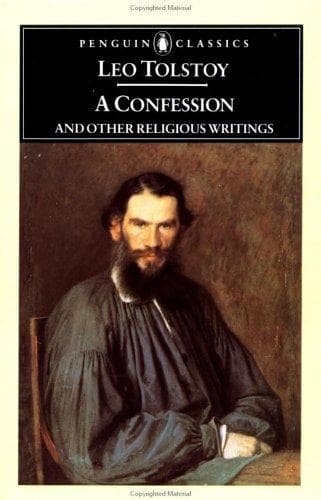
A Confession
اعتراف
Une confession
Editorial summary
Tolstoy's A Confession presents a profound autobiographical account of religious crisis and spiritual transformation that contributes significantly to existential approaches to the question of God. Writing in the aftermath of his literary success with War and Peace and Anna Karenina, Tolstoy chronicles his descent into suicidal despair despite possessing wealth, fame, and family happiness. The work traces his intellectual journey from nihilistic atheism through various philosophical systems before arriving at a radical embrace of peasant Christianity.
The text opens with Tolstoy's loss of Orthodox faith in his youth, followed by decades of secular literary achievement. However, at age 50, he confronts an overwhelming sense of life's meaninglessness that renders all human activities absurd in the face of inevitable death. This existential crisis drives him to examine how others cope with mortality's shadow. He investigates four possible responses: ignorance, hedonistic escape, suicide, and weakness. Finding all inadequate, Tolstoy turns to philosophy and science, studying Schopenhauer, Kant, and Solomon, yet discovers only confirmation of life's futility in rational thought.
The work's pivotal contribution lies in Tolstoy's argument that rational knowledge inherently leads to nihilism, while faith provides the only genuine answer to life's meaning. He observes that peasants, unlike the educated elite, maintain joy and purpose through simple religious faith. This leads to his controversial conclusion: true life requires abandoning rational philosophy for intuitive spiritual knowledge. Tolstoy distinguishes between the corrupt institutional church and authentic Christianity found among common believers.
Methodologically, A Confession employs introspective phenomenology combined with social observation. Tolstoy scrutinizes his own psychological states while simultaneously conducting an informal ethnography of Russian religious life. His critique targets Enlightenment rationalism and the intelligentsia's spiritual emptiness, positioning faith as a necessary condition for meaningful existence rather than an intellectual proposition.
The work's influence extends beyond religious philosophy into existentialism, psychology, and literary modernism. Its unflinching examination of suicidal ideation, its challenge to purely rational worldviews, and its validation of simple faith over sophisticated theology establish it as a crucial text in modern discussions of religious experience and the limits of reason in addressing ultimate questions.
Argument formulations engaged
Related works
Tolstoy, Leo (1882). A Confession.
@book{a-confession-1882,
  author    = {Tolstoy, Leo},
  title     = {A Confession},
  year      = {1882},
  url       = {https://god-database.com/en/works/a-confession-1882}
}