
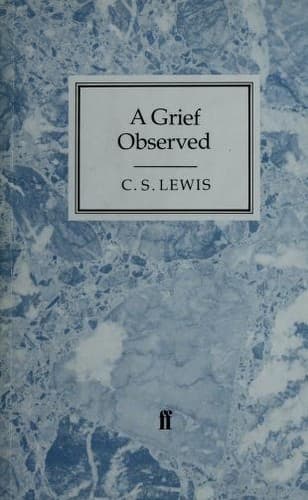
A Grief Observed
حزن ملاحظ
Un Chagrin Observé
Editorial summary
Following the death of his wife Joy Davidman, C.S. Lewis produces a raw examination of faith under the pressure of profound grief. Unlike his earlier apologetic works that construct systematic arguments for Christianity, A Grief Observed presents an unfiltered record of Lewis's struggle to reconcile his theological convictions with the brutal reality of loss. The work takes the form of journal entries, tracking the author's movement through various stages of grief while simultaneously documenting a crisis of faith that calls into question his previous certainties about God's nature and purposes.
Lewis begins with stark honesty about his experience: God appears absent precisely when most needed, feeling like a door slammed in the face of desperate prayer. This phenomenological approach marks a significant departure from Lewis's typical method of rational argumentation. Rather than defending theism, he interrogates it from within, voicing doubts about divine goodness that echo classical problems of theodicy but with an immediacy born of personal anguish. He questions whether his previous faith was merely a "house of cards" and whether God might be a "Cosmic Sadist" who delights in human suffering.
The work's philosophical significance lies in its refusal to resolve these tensions through facile answers. Lewis rejects both the consolations of conventional piety and his own earlier confidence in rational theodicy. Instead, he documents a gradual transformation in his understanding of faith itself—from intellectual assent to propositions about God to a more complex relationship that can encompass doubt, anger, and uncertainty. This shift represents a move from what might be termed "first-order" theism (belief in God's existence and attributes) to "second-order" theism (faith that persists through and is shaped by the experience of divine absence).
While Lewis ultimately reaffirms his Christian faith, the work's enduring contribution to philosophy of religion lies not in this conclusion but in its methodological innovation. By privileging lived experience over abstract argumentation, A Grief Observed anticipates later developments in phenomenology of religion and narrative theology. It demonstrates how personal testimony can function as philosophical argument, suggesting that the question of God cannot be adequately addressed through purely theoretical means but requires attention to the concrete realities of human suffering and the transformations of belief under existential pressure.
Argument formulations engaged
Related works
Lewis, C.S. (1961). A Grief Observed. Faber and Faber.
@book{a-grief-observed-1961,
  author    = {Lewis, C.S.},
  title     = {A Grief Observed},
  year      = {1961},
  publisher = {Faber and Faber},
  url       = {https://god-database.com/en/works/a-grief-observed-1961}
}