
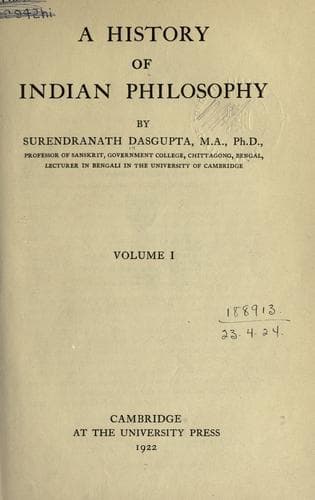
A History of Indian Philosophy Vol.3
تاريخ الفلسفة الهندية المجلد 3
Une histoire de la philosophie indienne Vol.3
Editorial summary
Surendranath Dasgupta's third volume of A History of Indian Philosophy (1940) provides a comprehensive examination of theistic developments within Indian philosophical traditions, with particular emphasis on the Vaishnava schools and their sophisticated arguments for divine existence and nature. This volume represents a crucial contribution to understanding how Indian philosophy approaches questions of God through systematic metaphysical analysis rather than mere devotional assertion.
The work meticulously traces the evolution of theistic philosophy from the Pancaratra system through various Vaishnava schools, demonstrating how Indian thinkers developed rigorous philosophical frameworks to establish God's existence, attributes, and relationship to the world. Dasgupta shows how these philosophers engaged with and responded to challenges from non-theistic schools like Buddhism and Samkhya, creating sophisticated defenses of theism that rival Western theological arguments in their complexity and rigor.
Central to Dasgupta's analysis is his exposition of how Indian theistic philosophers addressed fundamental questions about divine causation, the problem of evil, and the relationship between an infinite God and finite creation. He examines how thinkers like Ramanuja developed the concept of vishishtadvaita (qualified non-dualism) to maintain both God's transcendence and immanence, while later philosophers like Madhva argued for a more radical dualism between God and souls. The volume illuminates how these debates shaped distinctively Indian approaches to perennial theological problems.
Dasgupta employs a historical-philosophical method that combines textual analysis with systematic exposition of arguments. He situates each school within its intellectual context, showing how theistic philosophy emerged partly in response to Shankara's non-dualistic interpretation of Vedanta. His approach reveals how Indian philosophers developed unique solutions to questions about divine knowledge, freedom, and providence that differ markedly from Western theological traditions.
The significance of this volume lies in its demonstration that Indian philosophy contains sophisticated theistic traditions that deserve serious consideration in global discussions about God. Dasgupta's work challenges the common Western assumption that Indian philosophy is predominantly monistic or atheistic, revealing instead a rich tradition of philosophical theism that offers distinctive perspectives on divine reality, religious epistemology, and the relationship between philosophy and spiritual practice.
Argument formulations engaged
Dasgupta, Surendranath (1940). A History of Indian Philosophy Vol.3. Cambridge University Press.
@book{a-history-of-indian-philosophy-vol-3-194,
  author    = {Dasgupta, Surendranath},
  title     = {A History of Indian Philosophy Vol.3},
  year      = {1940},
  publisher = {Cambridge University Press},
  url       = {https://god-database.com/en/works/a-history-of-indian-philosophy-vol-3-1940}
}