
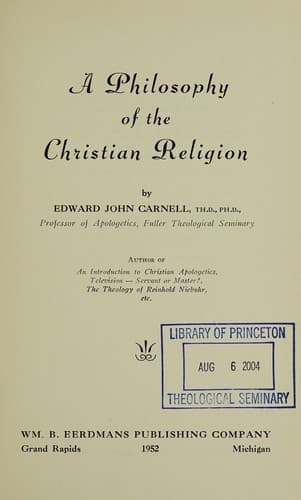
A Philosophy of the Christian Religion
فلسفة الدين المسيحي
Une philosophie de la religion chrétienne
Editorial summary
Carnell's A Philosophy of the Christian Religion presents a comprehensive philosophical defense of Christianity as the most rationally satisfying worldview available to modern humanity. Writing in the early 1950s against the backdrop of existentialism, logical positivism, and rising secularism, Carnell attempts to demonstrate that Christian theism provides superior answers to fundamental questions of meaning, morality, and human existence than its philosophical competitors.
The work employs a distinctive methodology that combines elements of presuppositional apologetics with evidential arguments. Carnell argues that every worldview ultimately rests on unprovable first principles, but Christianity's foundational assumptions lead to a more coherent and livable philosophy than alternatives. He systematically examines competing worldviews including naturalism, idealism, and various forms of humanism, demonstrating what he sees as their internal contradictions and existential inadequacies. His approach differs from traditional natural theology by beginning with the human predicament rather than abstract metaphysical proofs.
Central to Carnell's argument is his analysis of the human condition as characterized by guilt, meaninglessness, and the fear of death. He contends that only Christian theism adequately addresses these existential realities through its doctrines of sin, redemption, and eternal life. The work engages critically with contemporary philosophers including John Dewey, Bertrand Russell, and Jean-Paul Sartre, arguing that their systems ultimately fail to provide sufficient grounding for human dignity, moral obligation, and hope.
Carnell develops a nuanced epistemology that acknowledges both the role of faith and the importance of rational reflection. He rejects both fideism and pure rationalism, advocating instead for what he terms "systematic consistency" - the view that Christian truth claims must be internally coherent and correspond to lived experience. This middle position attempts to navigate between fundamentalist anti-intellectualism and liberal theological accommodation to secular thought.
The monograph's significance lies in its sophisticated engagement with mid-twentieth century philosophy from an evangelical perspective. Carnell demonstrates that conservative Christian thought need not retreat into intellectual isolation but can critically appropriate philosophical insights while maintaining orthodox commitments. His work influenced a generation of evangelical philosophers and apologists, helping establish philosophy of religion as a legitimate academic discipline within conservative Protestant institutions. The text remains relevant for understanding how Christian thinkers responded to modernity's challenges while attempting to preserve traditional theological convictions.
Argument formulations engaged
Carnell, Edward John (1952). A Philosophy of the Christian Religion. University of Chicago Press.
@book{a-philosophy-of-the-christian-religion-1,
  author    = {Carnell, Edward John},
  title     = {A Philosophy of the Christian Religion},
  year      = {1952},
  publisher = {University of Chicago Press},
  url       = {https://god-database.com/en/works/a-philosophy-of-the-christian-religion-1952}
}