
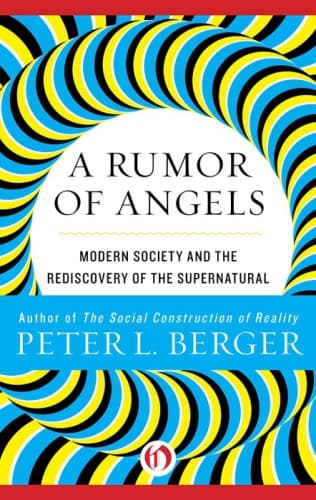
A Rumor of Angels: Modern Society and the Rediscovery of the Supernatural
شائعة الملائكة: المجتمع الحديث وإعادة اكتشاف الغيبي
Une rumeur d'anges : la société moderne et la redécouverte du surnaturel
Editorial summary
This sociological analysis examines how modern Western society has marginalized religious experience while simultaneously revealing persistent "signals of transcendence" that point toward supernatural reality. Peter L. Berger, writing against the dominant secularization thesis of the 1960s, argues that modernity has not eliminated the human capacity for religious experience but has instead created a "plausibility structure" that systematically discredits such experiences. The work represents a significant departure from conventional sociological treatments of religion that assume inevitable decline in the face of modernization.
Berger employs a phenomenological approach to identify what he terms "signals of transcendence" - ordinary human experiences that appear to point beyond the empirical world. These include the human propensity for order, the experience of play, the phenomenon of hope, the act of moral condemnation, and encounters with humor. Each of these, he contends, contains an implicit rejection of the notion that empirical reality exhausts all that is real. The argument for order, for instance, suggests that human beings possess an innate confidence in the ultimate intelligibility of reality that transcends merely evolutionary explanations.
The work directly challenges both sociological determinism and theological liberalism of the period. Against sociologists who view religion as merely a social construction destined for obsolescence, Berger argues that the persistence of religious experience even within secular contexts suggests something more fundamental about human nature. Against theological liberals who accommodate religious belief to modern secular assumptions, he maintains that authentic religious experience requires recognition of genuine transcendence rather than reduction to ethical or psychological categories.
Berger's method combines sociological analysis with philosophical argument, drawing on thinkers from Weber to Otto while maintaining accessibility for general readers. His concept of "inductive faith" - beginning with human experience rather than revealed doctrine - offers a middle path between fundamentalist certainty and secular dismissal. The work's significance lies in its early challenge to secularization theory and its sophisticated argument that modern society's very attempts to suppress the supernatural paradoxically reveal its persistent presence. By grounding his case in universal human experiences rather than specific religious traditions, Berger provides a broadly applicable framework for understanding religious persistence in modern contexts.
Argument formulations engaged
Berger, Peter L. (1969). A Rumor of Angels: Modern Society and the Rediscovery of the Supernatural. Open Road Media.
@book{a-rumor-of-angels-modern-society-and-the,
  author    = {Berger, Peter L.},
  title     = {A Rumor of Angels: Modern Society and the Rediscovery of the Supernatural},
  year      = {1969},
  publisher = {Open Road Media},
  url       = {https://god-database.com/en/works/a-rumor-of-angels-modern-society-and-the-rediscovery-of-the-supernatural-1969}
}