
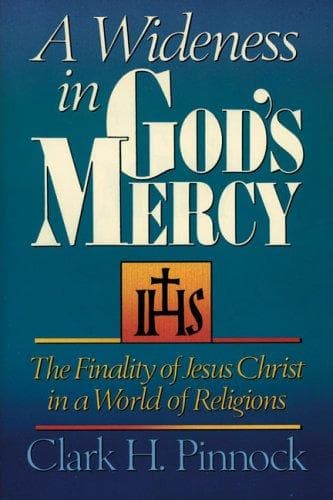
A Wideness in God's Mercy: The Finality of Jesus Christ in a World of Religions
رحابة في رحمة الله: نهائية يسوع المسيح في عالم الأديان
Une largesse dans la miséricorde de Dieu : la finalité de Jésus-Christ dans un monde de religions
Editorial summary
Clark Pinnock's monograph enters the contentious debate over religious pluralism and Christian exclusivism by proposing a mediating position that maintains Christ's finality while allowing for God's salvific presence beyond Christianity. Writing against both evangelical exclusivists who restrict salvation to explicit Christian faith and pluralists like John Hick who relativize all religious claims, Pinnock develops what he terms an "inclusivist" theology that expands the scope of divine mercy without abandoning orthodox Christology.
The work's central argument rests on distinguishing between the ontological necessity of Christ's atonement and the epistemological requirement of conscious faith in Jesus. Pinnock contends that while salvation remains grounded exclusively in Christ's work, God's prevenient grace operates throughout human history and across religious boundaries. He draws on patristic concepts like the logos spermatikos and builds upon Vatican 2's openness to non-Christian religions, while maintaining evangelical commitments to biblical authority and Christ's uniqueness.
Methodologically, Pinnock combines systematic theology with comparative religion, examining how the Holy Spirit might work through other religious traditions as preparatio evangelica. He engages extensively with Karl Rahner's "anonymous Christian" concept while rejecting its implicit ecclesiocentrism. The monograph addresses the fate of the unevangelized, arguing that sincere seekers who respond to available light may receive salvation through Christ even without explicit knowledge of him. This position challenges traditional Reformed soteriology while stopping short of universalism.
The work's significance lies in its attempt to preserve evangelical orthodoxy while addressing modern religious diversity. Pinnock confronts the moral objections to exclusivism—that a loving God would not condemn those with no opportunity to hear the gospel—without embracing relativism. His proposal influences subsequent evangelical discussions on world religions, though critics argue he compromises biblical particularism.
The monograph contributes to philosophical theology by exploring how divine attributes of love and justice relate to religious epistemology. Pinnock's position that God judges according to available light raises questions about religious knowledge, moral responsibility, and the relationship between general and special revelation. His work represents a significant evangelical attempt to maintain Christianity's absolute claims while acknowledging God's universal salvific will, thereby reshaping debates about religious diversity within conservative Protestantism.
Argument formulations engaged
Pinnock, Clark (1992). A Wideness in God's Mercy: The Finality of Jesus Christ in a World of Religions.
@book{a-wideness-in-gods-mercy-the-finality-of,
  author    = {Pinnock, Clark},
  title     = {A Wideness in God's Mercy: The Finality of Jesus Christ in a World of Religions},
  year      = {1992},
  url       = {https://god-database.com/en/works/a-wideness-in-gods-mercy-the-finality-of-jesus-christ-in-a-world-of-religions-1992}
}