
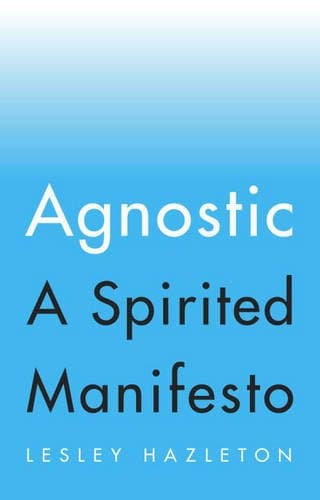
Agnostic: A Spirited Manifesto
اللاأدري: بيان حيوي
Agnostique : un manifeste plein de fougue
Agnosticism is not a weak or evasive middle ground but a principled, intellectually courageous stance that embraces the irreducible mystery of existence and resists the false certainties of both theism and atheism.
Editorial summary
Lesley Hazleton's "Agnostic: A Spirited Manifesto" presents a vigorous defense of agnosticism as a distinct and valuable philosophical position in contemporary debates about God's existence. Writing within the secular-naturalist tradition, Hazleton challenges the prevalent binary of theism versus atheism, arguing that agnosticism represents not merely indecision or fence-sitting, but rather a principled stance grounded in epistemic humility.
The work employs an essayistic-philosophical methodology that weaves personal reflection with broader intellectual inquiry. Hazleton draws on her background as a former psychologist and Middle East correspondent to craft an accessible yet substantive exploration of what it means to live with uncertainty about ultimate questions. Her approach deliberately eschews the technical apparatus of academic philosophy in favor of a more literary style that nonetheless engages seriously with fundamental epistemological issues.
Central to Hazleton's argument is the claim that agnosticism embodies a mature recognition of human cognitive limitations regarding transcendent matters. She positions herself against what she perceives as the dogmatic certainties of both religious fundamentalism and militant atheism, particularly targeting the New Atheist movement's claims to definitive knowledge about God's non-existence. The work argues that both theistic and atheistic positions often overreach in their confidence about matters that lie beyond empirical verification or falsification.
The manifesto's significance lies in its attempt to rehabilitate agnosticism from common misperceptions. Hazleton contends that rather than representing intellectual laziness or spiritual apathy, agnosticism requires courage to maintain openness in the face of uncertainty. She frames this stance as particularly relevant in an era marked by polarization between religious and secular worldviews. The work suggests that agnosticism offers a valuable middle path that respects both the human impulse toward transcendence and the demands of rational inquiry.
While some critics might argue that Hazleton's position ultimately collapses into practical atheism, her work makes a compelling case for agnosticism as a substantive philosophical stance. The manifesto contributes to contemporary God debates by articulating how epistemic humility can function not as an endpoint but as a generative principle for ongoing inquiry. Her emphasis on living creatively with uncertainty offers a distinctive voice in discussions often dominated by more absolutist positions on both sides of the theistic divide.
Structured analysis
Hazleton, Lesley Agnostic: A Spirited Manifesto. Riverhead Books.
@book{agnostic-a-spirited-manifesto,
  author    = {Hazleton, Lesley},
  title     = {Agnostic: A Spirited Manifesto},
  year      = {n.d.},
  publisher = {Riverhead Books},
  url       = {https://god-database.com/en/works/agnostic-a-spirited-manifesto}
}