
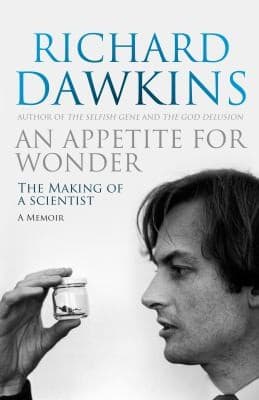
An Appetite for Wonder: The Making of a Scientist
شهية للعجب: صنع عالم
Un appétit pour l'émerveillement : La formation d'un scientifique
Editorial summary
Richard Dawkins' memoir An Appetite for Wonder: The Making of a Scientist chronicles the first half of his life, from childhood through the publication of The Selfish Gene in 1976. While primarily autobiographical, the work provides significant insight into the intellectual formation of one of contemporary atheism's most prominent advocates, revealing the experiential and theoretical foundations that would later inform his critique of religious belief.
The narrative traces Dawkins' early exposure to Anglican Christianity during his childhood in colonial Africa and boarding school education in England. He describes his gradual movement away from religious faith during adolescence, presenting this transition as a natural consequence of scientific education and critical thinking. This personal journey from belief to atheism serves as an implicit argument for the incompatibility of religious faith with scientific reasoning, a theme that would dominate his later polemical works.
Of particular significance is Dawkins' account of his introduction to evolutionary theory at Oxford under the tutelage of Niko Tinbergen. He presents his discovery of natural selection's explanatory power as a revelatory experience that definitively answered questions previously addressed by religious explanations. The memoir positions Darwinian evolution not merely as a scientific theory but as a comprehensive worldview that renders supernatural explanations obsolete.
The work engages indirectly with theological arguments through its treatment of design and purpose in nature. Dawkins describes how his early scientific work on animal behavior reinforced his conviction that apparent design requires no designer, only the algorithmic process of natural selection. This autobiographical framing of the design argument adds a personal dimension to debates he would later pursue more systematically in works like The Blind Watchmaker.
While ostensibly focused on scientific autobiography, the memoir functions as a subtle polemic against religious education and thinking. Dawkins presents his own intellectual development as exemplary, suggesting that proper scientific education naturally leads to atheistic conclusions. The work contributes to contemporary debates about science and religion by grounding abstract arguments in lived experience, implying that atheism represents not merely an intellectual position but the inevitable outcome of unencumbered rational development. Through this personal narrative, Dawkins constructs an implicit argument that religious belief persists primarily due to childhood indoctrination and inadequate exposure to scientific thinking.
Argument formulations engaged
Related works
Dawkins, Richard (2013). An Appetite for Wonder: The Making of a Scientist. Bantam Press.
@book{an-appetite-for-wonder-the-making-of-a-s,
  author    = {Dawkins, Richard},
  title     = {An Appetite for Wonder: The Making of a Scientist},
  year      = {2013},
  publisher = {Bantam Press},
  url       = {https://god-database.com/en/works/an-appetite-for-wonder-the-making-of-a-scientist-2013}
}