
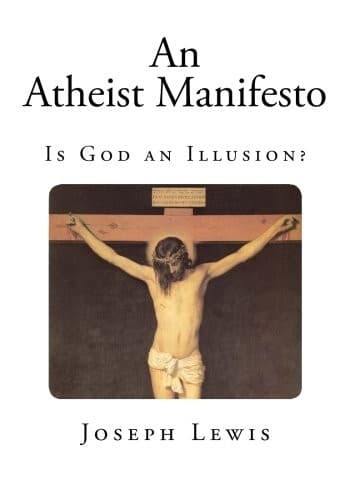
An Atheist Manifesto
بيان ملحد
Un manifeste athée
Editorial summary
This impassioned polemic represents a significant contribution to mid-twentieth century American atheist literature, articulating a comprehensive case against religious belief through historical, scientific, and moral arguments. Joseph Lewis, a prominent figure in American freethought activism, structures his manifesto as a systematic demolition of theistic claims, targeting both the philosophical foundations of God-belief and the social institutions that perpetuate religious authority.
Lewis employs a rationalist methodology that draws heavily on Enlightenment critiques of religion, particularly those of Thomas Paine and Robert Ingersoll, while incorporating contemporary scientific discoveries to challenge biblical literalism. His approach combines historical analysis of religious development with empirical arguments about natural phenomena, contending that scientific explanation renders supernatural hypotheses obsolete. The work engages directly with Christian apologetics of the period, offering counter-arguments to design arguments, moral arguments, and appeals to religious experience.
Central to Lewis's thesis is the claim that belief in God constitutes not merely an intellectual error but an active impediment to human progress and moral development. He argues that theism perpetuates ignorance, sanctions cruelty, and inhibits scientific advancement. The manifesto particularly emphasizes the historical crimes committed in religion's name, from the Inquisition to contemporary censorship, presenting these as inevitable consequences of faith-based thinking rather than aberrations.
The work's significance lies partly in its timing, appearing during the Cold War period when American atheism faced considerable social stigma and political suspicion. Lewis's unapologetic stance challenged the prevailing cultural equation of godlessness with communism, asserting instead that atheism represents the culmination of American democratic and scientific values. His manifesto helped establish rhetorical strategies and argumentative frameworks that would influence later atheist writers.
While Lewis's arguments largely rehearse classical critiques of religion, his synthesis and popularization of these ideas for a mid-century American audience marks an important moment in the development of organized atheism. The work's confrontational tone and comprehensive scope make it a notable example of atheist advocacy literature, demonstrating how rationalist critique could be mobilized not merely as philosophical position but as a call for social transformation. Its influence extends beyond academic philosophy into the broader cultural discourse about religion's role in modern society.
Argument formulations engaged
Lewis, Joseph (1954). An Atheist Manifesto. St. Martin's Press.
@book{an-atheist-manifesto-1954,
  author    = {Lewis, Joseph},
  title     = {An Atheist Manifesto},
  year      = {1954},
  publisher = {St. Martin's Press},
  url       = {https://god-database.com/en/works/an-atheist-manifesto-1954}
}