
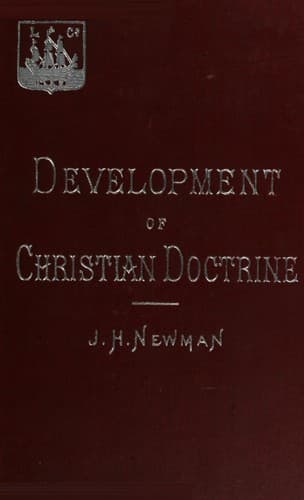
An Essay on the Development of Christian Doctrine
مقال في تطور العقيدة المسيحية
Essai sur le développement de la doctrine chrétienne
Editorial summary
This landmark work examines how Christian doctrine legitimately develops over time while maintaining continuity with apostolic revelation. Newman argues that doctrinal development represents not corruption but organic growth guided by divine providence, thus defending both Catholic tradition and the rationality of religious belief against Protestant and secular critics.
Newman identifies seven criteria distinguishing authentic development from corruption: preservation of type, continuity of principles, power of assimilation, logical sequence, anticipation of its future, conservative action upon its past, and chronic vigor. Through extensive historical analysis, he demonstrates how doctrines like papal supremacy, Marian teachings, and purgatory emerged through legitimate elaboration of scriptural seeds rather than foreign accretion. The Church serves as the divinely appointed guardian ensuring faithful development under the Holy Spirit's guidance.
The work responds to multiple challenges facing nineteenth-century Christianity. Against Protestant claims that Catholicism corrupted primitive Christianity, Newman shows doctrinal development as intrinsic to any living idea. Against rationalist historians who viewed religious change as purely human evolution, he presents development as supernatural fulfillment of divine promises. Against liberal theologians reducing Christianity to moral principles, he defends the intellectual content and propositional nature of revealed truth.
Newman's philosophical approach draws on contemporary German idealism while remaining distinctly theological. He employs an empirical method, examining historical evidence of how Christian communities actually interpreted and applied revelation across centuries. This historical consciousness, combined with logical analysis of how ideas naturally unfold, provides a sophisticated response to Enlightenment critiques of traditional authority.
The essay's significance extends beyond Catholic apologetics. Newman offers a theory of religious epistemology addressing how finite minds apprehend infinite truth progressively. His account of development influences subsequent reflection on tradition, biblical interpretation, and religious authority across denominations. By showing how fidelity requires change, he provides resources for understanding God's ongoing relationship with human history.
The work assumes God's existence and active providence, presenting Christianity as divinely revealed truth requiring an authoritative interpreter. Newman's argument that religious understanding deepens through communal reflection guided by the Spirit offers a distinctly theistic account of how humans come to knowledge of God. His defense of supernatural revelation against reductionist explanations establishes this as a robustly theistic contribution to modern religious thought.
Argument formulations engaged
Newman, John Henry (1845). An Essay on the Development of Christian Doctrine. University of Notre Dame Press.
@book{an-essay-on-the-development-of-christian,
  author    = {Newman, John Henry},
  title     = {An Essay on the Development of Christian Doctrine},
  year      = {1845},
  publisher = {University of Notre Dame Press},
  url       = {https://god-database.com/en/works/an-essay-on-the-development-of-christian-doctrine-1845}
}