
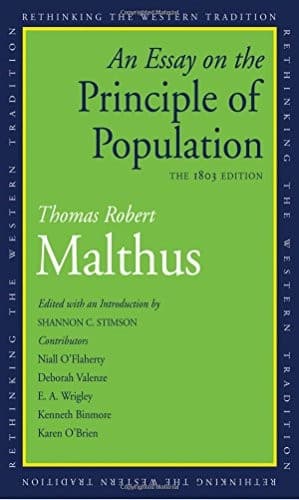
An Essay on the Principle of Population
مقال في مبدأ السكان
Essai sur le principe de population
Editorial summary
This seminal work by Thomas Malthus presents a systematic analysis of population dynamics that carries profound implications for theodicy and natural theology. Writing against the optimistic perfectibilism of William Godwin and the Marquis de Condorcet, Malthus argues that population growth inherently outpaces food supply, creating inevitable cycles of misery that constrain human progress. His principle states that population increases geometrically while subsistence grows only arithmetically, establishing what he considers an immutable natural law ordained by divine providence.
The theological significance of Malthus's argument lies in his treatment of suffering and scarcity as necessary features of God's design rather than evils to be eliminated. He contends that the pressure of population against resources serves a divine purpose by stimulating human industry, virtue, and moral restraint. This framework recasts apparent natural evils as instruments of moral education and social order. Malthus explicitly rejects the notion that a benevolent deity would create a world without struggle, arguing instead that adversity forms an essential component of God's plan for human development.
The work engages directly with Enlightenment debates about providence and progress. Against philosophers who envision unlimited human perfectibility through reason and social reform, Malthus posits divinely established limits that render utopian schemes not merely impractical but contrary to God's intentions. His methodology combines empirical observation of population data with deductive reasoning from first principles about human nature and divine purpose. This synthesis of natural philosophy and theology positions his essay within the tradition of physico-theology while challenging its more optimistic variants.
Malthus's influence extends beyond demographics to shape subsequent discussions of divine justice, natural evil, and social ethics. His argument that inequality and hardship reflect divine wisdom rather than divine neglect provides a theodicy grounded in natural law rather than revelation. Later thinkers, including Darwin, would adapt his population principle while stripping away its theological framework. However, Malthus himself maintains throughout that the principle of population demonstrates God's wisdom in creating a world where moral and intellectual faculties develop through struggle. The essay thus represents a significant contribution to natural theology's engagement with empirical science and social theory in addressing perennial questions about divine providence and the problem of evil.
Argument formulations engaged
Malthus, Thomas (1798). An Essay on the Principle of Population.
@book{an-essay-on-the-principle-of-population-,
  author    = {Malthus, Thomas},
  title     = {An Essay on the Principle of Population},
  year      = {1798},
  url       = {https://god-database.com/en/works/an-essay-on-the-principle-of-population-1798}
}