
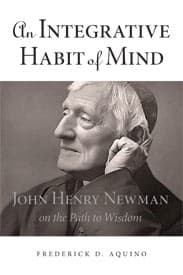
An Integrative Habit of Mind: John Henry Newman on the Path to Wisdom
عادة عقلية تكاملية: جون هنري نيومان على طريق الحكمة
Une habitude intégratrice de l'esprit : John Henry Newman sur le chemin de la sagesse
Editorial summary
This volume examines John Henry Newman's philosophical and theological contributions to understanding wisdom as an integrative intellectual virtue. Frederick D. Aquino assembles essays that explore how Newman's thought provides resources for developing what might be termed a "wisdom epistemology" - an approach to knowledge that emphasizes the integration of diverse forms of understanding rather than their compartmentalization.
The work situates Newman within contemporary debates about virtue epistemology and the relationship between religious belief and rational inquiry. Newman emerges as a thinker who resists both fideism and rationalism, instead proposing that genuine wisdom requires what he calls the "illative sense" - a capacity for judgment that integrates logical reasoning with imagination, conscience, and experience. This integrative habit of mind stands in contrast to narrower conceptions of rationality that dominated much nineteenth-century thought and continue to influence contemporary epistemology.
Central to the volume's argument is Newman's understanding of how religious belief functions within a broader framework of human knowing. Rather than treating faith as a leap beyond reason or reducing it to logical demonstration, Newman presents religious conviction as arising from a convergence of probabilities assessed by a mind trained in making complex judgments. This approach challenges both religious fundamentalism and secular dismissals of religious belief as inherently irrational.
The contributors examine how Newman's educational philosophy, developed during his years at Oxford and Dublin, embodies this integrative vision. Liberal education, for Newman, cultivates the philosophical habit of viewing knowledge as an interconnected whole rather than isolated specialties. This educational ideal connects directly to questions about God, as it suggests that theological understanding cannot be separated from broader humanistic learning.
The volume demonstrates Newman's relevance to current discussions about intellectual virtue, the role of tradition in rational inquiry, and the relationship between faith and reason. By presenting wisdom as an intellectual excellence that transcends disciplinary boundaries, Newman offers a middle path between dogmatic certainty and skeptical relativism. His approach suggests that questions about God cannot be adequately addressed through purely logical analysis or empirical investigation alone, but require the cultivation of integrative judgment that draws upon the full range of human faculties and experiences.
Argument formulations engaged
Aquino, Frederick D. (2012). An Integrative Habit of Mind: John Henry Newman on the Path to Wisdom. Cornell University Press.
@book{an-integrative-habit-of-mind-john-henry-,
  author    = {Aquino, Frederick D.},
  title     = {An Integrative Habit of Mind: John Henry Newman on the Path to Wisdom},
  year      = {2012},
  publisher = {Cornell University Press},
  url       = {https://god-database.com/en/works/an-integrative-habit-of-mind-john-henry-newman-on-the-path-to-wisdom-2012}
}