
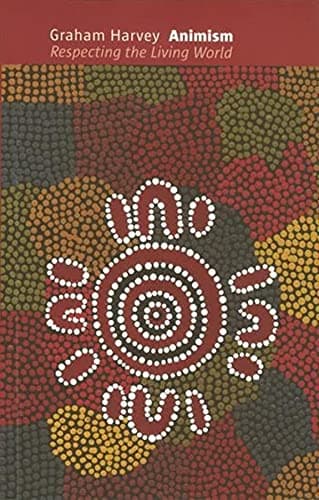
Animism: Respecting the Living World
الأرواحية: احترام العالم الحي
Animisme : Respecter le monde vivant
Editorial summary
Graham Harvey's monograph presents a comprehensive reexamination of animism that challenges traditional Western academic and theological frameworks for understanding religious phenomena. Rather than treating animism as a primitive error or pre-religious worldview, Harvey argues that animist ontologies represent sophisticated philosophical systems that recognize personhood, agency, and relationality in non-human entities. His work directly confronts the legacy of E.B. Tylor's 19th-century characterization of animism as failed primitive science, proposing instead that animist traditions offer valuable insights into human-environment relationships that Western thought has systematically overlooked.
The text employs ethnographic analysis drawn from diverse cultural contexts, including indigenous communities in North America, Southeast Asia, and Africa, to demonstrate how animist worldviews function as coherent systems of knowledge and practice. Harvey's methodology combines anthropological fieldwork with philosophical analysis, drawing on the "new animism" scholarship pioneered by researchers like Nurit Bird-David and Philippe Descola. This approach allows him to articulate how animist perspectives challenge Western dualistic separations between nature and culture, subject and object, sacred and secular.
Central to Harvey's argument is the claim that animism represents not merely a set of beliefs about spirits inhabiting natural objects, but rather a relational ontology that recognizes the world as populated by diverse persons, only some of whom are human. This perspective has significant implications for debates about the nature of divinity and religious experience. By demonstrating that animist traditions operate with fundamentally different assumptions about personhood, agency, and the sacred, Harvey's work undermines universalist claims about religious evolution or development that have historically positioned monotheism as the apex of spiritual sophistication.
The monograph's contribution to discussions of God lies primarily in its expansion of the conceptual framework for understanding divinity and the sacred. Harvey shows how animist traditions distribute sacred power throughout the cosmos rather than concentrating it in a single transcendent deity, thereby challenging both theistic and atheistic positions that assume a particular model of what God must be. His analysis suggests that Western debates about God's existence may be culturally limited, failing to account for alternative ways of experiencing and conceptualizing the sacred. The work thus opens space for reconsidering fundamental categories in religious studies and theology, advocating for greater attention to indigenous and non-Western perspectives in academic discussions of religion, divinity, and ultimate reality.
Argument formulations engaged
Harvey, Graham (2005). Animism: Respecting the Living World. Columbia University Press.
@book{animism-respecting-the-living-world-2005,
  author    = {Harvey, Graham},
  title     = {Animism: Respecting the Living World},
  year      = {2005},
  publisher = {Columbia University Press},
  url       = {https://god-database.com/en/works/animism-respecting-the-living-world-2005}
}