
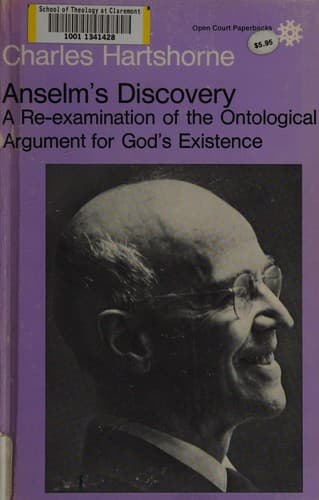
Anselm's Discovery
اكتشاف أنسلم
La découverte d'Anselme
Editorial summary
Charles Hartshorne's Anselm's Discovery represents a significant twentieth-century rehabilitation of the ontological argument for God's existence. The work demonstrates how Anselm's proof, particularly in its second formulation in Proslogion 3, contains logical insights that anticipate modal logic and remain philosophically viable when properly understood. Hartshorne argues that centuries of misinterpretation, beginning with Gaunilo and extending through Kant, have obscured Anselm's actual achievement.
The monograph systematically distinguishes between two forms of the ontological argument present in Anselm's work. While the first version in Proslogion 2 proves vulnerable to traditional objections, Hartshorne contends that the second version in Proslogion 3 represents the true discovery. This argument moves from the concept of God as that than which nothing greater can be conceived to the necessity of God's existence. Hartshorne employs modern modal logic to clarify how Anselm's insight concerns not mere existence but necessary existence, thereby avoiding the standard criticism that existence is not a predicate.
Hartshorne's interpretation challenges dominant philosophical narratives about the ontological argument's refutation. He demonstrates that Kant's famous critique targets only the weaker first formulation while missing the modal sophistication of Anselm's stronger second version. The work meticulously examines how philosophers from Aquinas to Hume failed to grasp the distinction between contingent and necessary existence that grounds Anselm's reasoning. Through careful textual analysis and logical reconstruction, Hartshorne shows that when God is properly conceived as the greatest conceivable being, the impossibility of God's nonexistence follows as a matter of logical necessity.
The monograph's significance extends beyond historical interpretation to contemporary philosophy of religion. Hartshorne's reformulation influences subsequent modal ontological arguments, particularly those developed by Malcolm, Plantinga, and others. His process theological framework shapes his reading, emphasizing how divine perfection entails necessary existence rather than static being. The work exemplifies analytical philosophy's engagement with medieval thought, demonstrating how rigorous logical analysis can revive arguments long considered defunct.
Hartshorne's contribution fundamentally alters scholarly understanding of the ontological argument. By recovering what he presents as Anselm's authentic insight, the monograph transforms a supposedly refuted medieval proof into a philosophically respectable argument deserving serious contemporary consideration. His interpretation establishes the ontological argument as addressing not whether God happens to exist but whether God's existence is logically necessary given the very concept of divinity.
Argument formulations engaged
Related works
Hartshorne, Charles (1965). Anselm's Discovery. Open Court.
@book{anselms-discovery-1965,
  author    = {Hartshorne, Charles},
  title     = {Anselm's Discovery},
  year      = {1965},
  publisher = {Open Court},
  url       = {https://god-database.com/en/works/anselms-discovery-1965}
}