
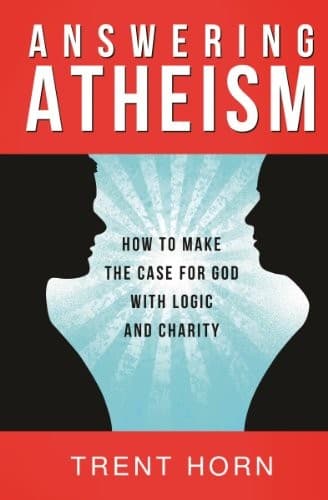
Answering Atheism
الرد على الإلحاد
Répondre à l'athéisme
Atheism fails to provide adequate rational grounds for rejecting God's existence, and classical theistic arguments—cosmological, teleological, and moral—together constitute a compelling cumulative case for belief in God.
Editorial summary
Trent Horn's "Answering Atheism" presents a systematic philosophical defense of theistic belief through careful engagement with contemporary atheist arguments. Writing within the Christian analytic tradition, Horn structures his work as a comprehensive response to the most prominent objections raised by the New Atheist movement, particularly addressing arguments advanced by Richard Dawkins, Christopher Hitchens, Sam Harris, and Daniel Dennett.
The monograph employs a methodical approach to philosophical argumentation, examining atheist critiques across three primary domains: metaphysical, scientific, and moral. In the metaphysical arena, Horn revitalizes classical cosmological arguments, particularly the argument from contingency, defending them against standard objections about infinite regress and the composition fallacy. He argues that atheist dismissals of first cause reasoning often misunderstand the nature of necessary existence and fail to adequately account for why contingent beings exist at all.
Regarding design arguments, Horn navigates the post-Darwinian landscape by focusing on cosmic fine-tuning rather than biological complexity. He contends that multiverse hypotheses, frequently invoked to explain apparent design, merely push the problem back without eliminating the need for explanation. The work engages critically with physicalist explanations while maintaining that the precise calibration of physical constants points toward intentional design.
Perhaps most significantly, Horn addresses moral arguments by challenging naturalistic accounts of objective morality. He examines attempts by atheist philosophers to ground moral realism in evolutionary biology or social contracts, arguing that such approaches cannot adequately explain the binding nature of moral obligations or the existence of intrinsic human dignity. The work particularly scrutinizes Sam Harris's attempt to derive ought from is through neuroscience and well-being maximization.
Throughout the monograph, Horn demonstrates familiarity with contemporary analytic philosophy, engaging not only with popular atheist writers but also with sophisticated philosophical naturalists like Graham Oppy and J.L. Mackie. His argumentative strategy combines defensive moves—showing why atheist objections fail—with positive cases for theistic belief. The work contributes to the God debate by providing philosophically rigorous responses to popular-level atheist arguments while making technical philosophical discussions accessible to educated general readers. Horn's systematic treatment offers a comprehensive resource for those seeking intellectual engagement with atheist challenges to religious belief.
Argument formulations engaged
Related works
Horn, Trent Answering Atheism. Catholic Answers Press.
@book{answering-atheism,
  author    = {Horn, Trent},
  title     = {Answering Atheism},
  year      = {n.d.},
  publisher = {Catholic Answers Press},
  url       = {https://god-database.com/en/works/answering-atheism}
}