
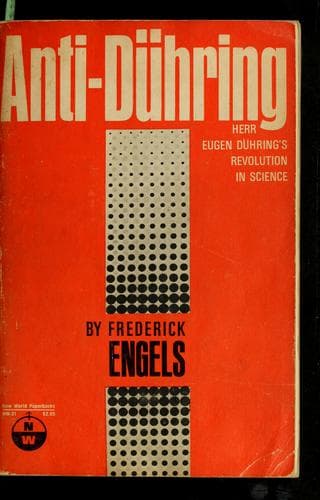
Anti-Dühring
ضد دوهرنغ
Editorial summary
Engels' Anti-Dühring represents a comprehensive materialist critique of idealist philosophy, with significant implications for nineteenth-century debates about religious belief and the existence of God. Written as a polemic against Eugen Dühring's philosophical system, the work develops a systematic exposition of dialectical materialism that fundamentally challenges theological and metaphysical accounts of reality.
The text advances a thoroughgoing naturalistic worldview that leaves no room for supernatural entities or divine intervention. Engels argues that all phenomena, including consciousness and human society, emerge from material processes governed by dialectical laws of motion and change. This framework explicitly rejects what Engels terms "metaphysical" thinking - the tendency to view categories as fixed, eternal, and divinely ordained. Instead, he proposes that nature, society, and thought develop through contradictions and transformations inherent in matter itself.
Engels' method combines philosophical argumentation with extensive reference to contemporary natural science, particularly physics, chemistry, and biology. He marshals evidence from these fields to demonstrate that scientific investigation progressively eliminates the need for religious explanations of natural phenomena. The work particularly emphasizes how Darwin's theory of evolution undermines teleological arguments for divine design, showing instead that complexity arises through natural processes without conscious direction.
The critique extends beyond natural philosophy to social analysis. Engels argues that religious belief itself emerges from specific material conditions, particularly the alienation produced by class society. Religion, in this account, represents an inverted consciousness that attributes to supernatural forces what actually results from human social relations. This analysis builds on Feuerbach's projection theory while grounding it more firmly in economic and social structures.
Anti-Dühring's significance for the God debate lies in its systematic articulation of a worldview that renders theistic belief not merely false but obsolete. Unlike earlier atheistic critiques that focused primarily on logical contradictions in religious doctrine, Engels presents a comprehensive alternative explanation for both natural phenomena and the phenomenon of religious belief itself. The work influenced subsequent Marxist approaches to religion and contributed to broader nineteenth-century trends toward naturalistic explanations in philosophy and social science. Its integration of natural science, social theory, and philosophical critique established a template for materialist challenges to religious worldviews that would prove influential well beyond socialist circles.
Argument formulations engaged
Related works
Engels, Friedrich (1878). Anti-Dühring. International Publishers.
@book{anti-d-hring-1878,
  author    = {Engels, Friedrich},
  title     = {Anti-Dühring},
  year      = {1878},
  publisher = {International Publishers},
  url       = {https://god-database.com/en/works/anti-d-hring-1878}
}