
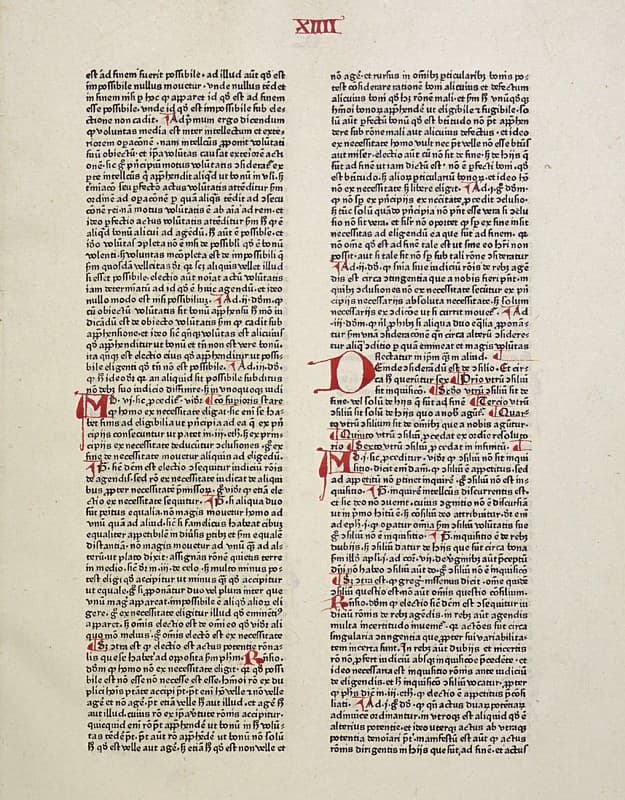
Aquinas's Summa Theologiae: A Guide and Commentary
خلاصة الأكويني اللاهوتية: دليل وتعليق
La Somme théologique d'Aquin : Guide et commentaire
Editorial summary
Brian Davies's comprehensive guide to Aquinas's Summa Theologiae provides both an accessible introduction and a sophisticated commentary on one of the most influential theological works in Western thought. Davies approaches the Summa not merely as a historical artifact but as a living philosophical text that continues to shape contemporary debates about God's existence, nature, and relationship to creation.
The work systematically explicates Aquinas's philosophical theology, paying particular attention to the Five Ways, the doctrine of divine simplicity, and the relationship between faith and reason. Davies demonstrates how Aquinas synthesizes Aristotelian philosophy with Christian theology to construct arguments that remain philosophically rigorous while being theologically orthodox. He emphasizes that Aquinas's proofs for God's existence function not as isolated arguments but as interconnected demonstrations within a broader metaphysical framework that understands God as ipsum esse subsistens—subsistent being itself.
Davies engages critically with modern interpreters and critics of Aquinas, particularly addressing objections raised by contemporary analytic philosophers of religion. He defends Aquinas against charges of anthropomorphism while explaining why classical theism differs fundamentally from modern personalist conceptions of God. The commentary illuminates how Aquinas's negative theology operates alongside his positive claims, showing that assertions about what God is not prove as crucial as affirmations about divine attributes.
The author situates Aquinas within his thirteenth-century intellectual context while demonstrating the enduring relevance of Thomistic arguments. Davies shows how Aquinas responds to Islamic and Jewish philosophy, particularly Avicenna and Maimonides, while developing distinctively Christian philosophical positions. The guide explores Aquinas's nuanced treatment of religious language, explaining how analogical predication allows meaningful discourse about God without reducing the divine to creaturely categories.
Throughout the commentary, Davies maintains that understanding Aquinas requires grasping his fundamental distinction between essence and existence in creatures versus their identity in God. This metaphysical insight grounds Aquinas's natural theology and shapes his approach to revealed theology. Davies's work serves scholars seeking deeper comprehension of Thomistic thought while remaining accessible to students encountering the Summa for the first time. By clarifying Aquinas's arguments and defending their philosophical cogency, Davies contributes to ongoing debates about whether reason can demonstrate God's existence and what such demonstrations might establish about the divine nature.
Argument formulations engaged
Related works
Davies, Brian (2014). Aquinas's Summa Theologiae: A Guide and Commentary. Oxford University Press.
@book{aquinass-summa-theologiae-a-guide-and-co,
  author    = {Davies, Brian},
  title     = {Aquinas's Summa Theologiae: A Guide and Commentary},
  year      = {2014},
  publisher = {Oxford University Press},
  url       = {https://god-database.com/en/works/aquinass-summa-theologiae-a-guide-and-commentary-2014}
}