
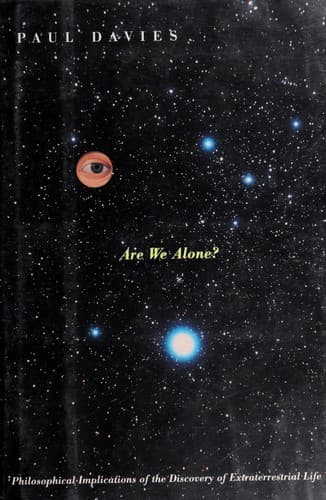
Are We Alone? Philosophical Implications of the Discovery of Extraterrestrial Life
هل نحن وحدنا؟ الآثار الفلسفية لاكتشاف الحياة خارج الأرض
Sommes-nous seuls ? Implications philosophiques de la découverte de vie extraterrestre
Editorial summary
This monograph examines how the discovery of extraterrestrial life would transform humanity's philosophical and religious worldview, particularly concerning concepts of God, purpose, and cosmic significance. Davies argues that contact with alien intelligence would precipitate a crisis in traditional Western theology while potentially opening new avenues for understanding divinity and humanity's place in the universe.
The work systematically explores three scenarios: the discovery of microbial life, complex non-intelligent organisms, and advanced civilizations. Davies contends that even simple extraterrestrial life would challenge anthropocentric religious frameworks that position Earth as God's unique creation. He argues that intelligent alien life would pose the most profound theological difficulties, particularly for doctrines of incarnation, salvation, and divine election that assume human uniqueness.
Davies engages critically with both religious traditionalists who maintain humanity's special status and scientific materialists who dismiss theological considerations entirely. Against the former, he demonstrates how major religious traditions have historically adapted to cosmological discoveries. Against the latter, he argues that the discovery of extraterrestrial life would intensify rather than eliminate questions about cosmic purpose and design. The author draws on process theology and panentheism to suggest how divinity might be reconceptualized in a populated universe.
The monograph's methodology combines philosophical analysis with scientific speculation, examining how different forms of extraterrestrial life would impact specific theological doctrines. Davies pays particular attention to the problem of multiple incarnations and whether salvation history could be universal or planet-specific. He argues that religions emphasizing divine immanence would adapt more readily than those stressing transcendence and special revelation.
Davies ultimately contends that discovering extraterrestrial life would catalyze a religious reformation comparable to the Copernican revolution. Rather than eliminating God from human consciousness, such a discovery might expand theological imagination toward more cosmic conceptions of divinity. The work contributes to the God debate by demonstrating how empirical discoveries shape theological possibilities and by arguing that science and religion must engage dialogically when confronting humanity's cosmic context. This prescient analysis anticipates contemporary discussions about astrobiology's philosophical implications and offers a framework for theological adaptation rather than abandonment in response to scientific discovery.
Argument formulations engaged
Davies, Paul (1995). Are We Alone? Philosophical Implications of the Discovery of Extraterrestrial Life. Basic Books.
@book{are-we-alone-philosophical-implications-,
  author    = {Davies, Paul},
  title     = {Are We Alone? Philosophical Implications of the Discovery of Extraterrestrial Life},
  year      = {1995},
  publisher = {Basic Books},
  url       = {https://god-database.com/en/works/are-we-alone-philosophical-implications-of-the-discovery-of-extraterrestrial-life-1995}
}