
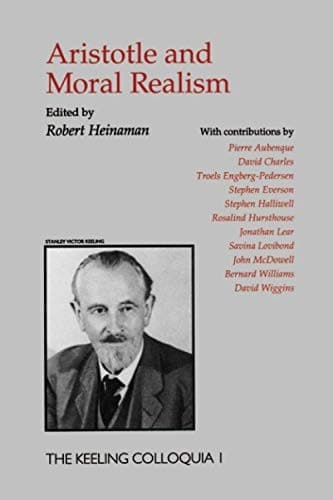
Aristotle And Moral Realism
أرسطو والواقعية الأخلاقية
Aristote et le réalisme moral
Aristotle's ethical thought provides a defensible foundation for moral realism, grounding objective moral facts in human nature and rational teleology rather than in divine command or subjective preference.
Editorial summary
This edited collection examines the foundations and implications of Aristotelian moral realism, exploring how Aristotle's ethical framework relates to contemporary metaethical debates. While the volume primarily addresses questions of moral ontology and epistemology, its engagement with Aristotelian metaphysics bears significantly on natural theology and theistic ethics.
The contributors analyze Aristotle's conception of moral facts as grounded in human nature and teleology, investigating whether this framework can support a robust moral realism without explicit theistic foundations. Several chapters examine how Aristotle's function argument and his account of eudaimonia depend on metaphysical commitments about natural purposes and final causes. This raises fundamental questions about whether moral realism requires a purposive universe—a consideration that traditionally points toward divine design.
A central tension emerges between naturalistic and theological interpretations of Aristotelian ethics. Some contributors argue that Aristotle's moral realism stands independently of theology, grounded solely in empirical observations about human flourishing and social life. Others contend that the teleological structure underlying Aristotelian ethics implicitly requires something like divine providence or cosmic purpose to guarantee the objectivity of moral facts. This debate illuminates broader questions about whether moral realism necessarily leads to theistic commitments.
The volume also addresses the relationship between Aristotelian virtue ethics and divine command theory. While Aristotle himself maintains that ethics concerns human affairs rather than divine commands, medieval appropriations of his thought—particularly by Aquinas—suggest deeper connections between natural law and divine reason. Contributors examine whether Aristotelian moral realism can coherently reject divine foundations while maintaining its claims to objectivity and universality.
Methodologically, the collection employs careful textual analysis alongside contemporary analytic philosophy, bringing Aristotelian insights into dialogue with modern debates about moral ontology. This approach reveals how ancient Greek philosophy continues to inform discussions about the metaphysical prerequisites for objective morality.
The work's significance for the God debate lies in its systematic exploration of whether robust moral realism requires theistic foundations. By examining Aristotle's attempt to ground ethics in human nature and rational reflection, the volume illuminates ongoing controversies about the relationship between morality and divinity. It demonstrates that questions about moral objectivity remain deeply entangled with questions about cosmic purpose and ultimate reality.
Structured analysis
Structure of the work
Argument formulations engaged
Heinaman, Robert (1995). Aristotle And Moral Realism. Westview Press.
@book{aristotle-and-moral-realism,
  author    = {Heinaman, Robert},
  title     = {Aristotle And Moral Realism},
  year      = {1995},
  publisher = {Westview Press},
  url       = {https://god-database.com/en/works/aristotle-and-moral-realism}
}