
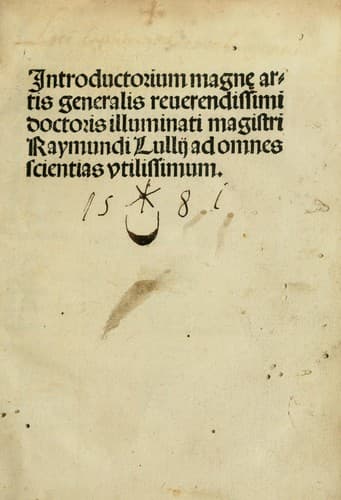
Ars Magna
الفن العظيم
Editorial summary
The Ars Magna represents Ramon Llull's most ambitious attempt to demonstrate the existence and attributes of God through a combinatorial method that anticipates later developments in formal logic and computation. Written in 1305 as the culmination of decades of refinement to his earlier works, this text presents a mechanical system for generating theological truths through the manipulation of symbolic elements representing divine attributes and principles.
Llull constructs his argument around the conviction that God's existence and nature can be proven through reason alone, without recourse to scriptural authority. His method employs rotating concentric circles inscribed with letters representing fundamental concepts such as Goodness, Greatness, Eternity, Power, Wisdom, Will, Virtue, Truth, and Glory. By combining these elements systematically, Llull claims to generate all possible true statements about God and creation. This combinatorial approach serves a dual purpose: demonstrating God's existence through the logical necessity of divine attributes, and providing a universal method for converting Muslims and Jews to Christianity through rational argumentation rather than force.
The work engages primarily with Islamic philosophy, particularly the Aristotelian tradition as interpreted by Ibn Rushd (Averroes), while also responding to contemporary Jewish thought. Llull argues against what he perceives as the limitations of Averroistic rationalism, which he believes fails to adequately bridge faith and reason. His system attempts to prove not only God's existence but also specifically Christian doctrines such as the Trinity and Incarnation, which he considers demonstrable through his logical apparatus.
The Ars Magna's significance extends beyond its immediate theological aims. It pioneers a mechanistic approach to reasoning that would influence later thinkers including Nicholas of Cusa and Giordano Bruno, and eventually contribute to Leibniz's development of symbolic logic. The text represents a unique moment in medieval thought where mystical contemplation meets proto-scientific method, attempting to reduce divine mystery to logical operations without diminishing transcendence.
Llull's project ultimately asserts that human reason, properly directed through his combinatorial art, can achieve certain knowledge of God. This optimistic rationalism distinguishes his approach from both the more skeptical Aristotelians and the fideistic tendencies within contemporary Franciscan thought, positioning the Ars Magna as a singular contribution to natural theology.
Argument formulations engaged
Llull, Ramon (1305). Ars Magna.
@book{ars-magna-1305,
  author    = {Llull, Ramon},
  title     = {Ars Magna},
  year      = {1305},
  url       = {https://god-database.com/en/works/ars-magna-1305}
}