
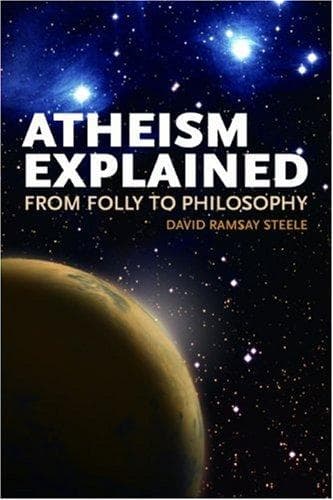
Atheism Explained: From Folly to Philosophy
الإلحاد مفسراً: من الحماقة إلى الفلسفة
L'athéisme expliqué : De la folie à la philosophie
Editorial summary
This comprehensive philosophical examination of atheism traces its historical development from ancient skepticism to contemporary naturalism, offering both a defense of atheistic reasoning and a systematic critique of theistic arguments. Steele structures his analysis around the evolution of atheistic thought, beginning with early Greek materialists and proceeding through Enlightenment critique to modern scientific atheism. The work distinguishes itself by treating atheism not merely as negation but as a coherent philosophical position with its own intellectual tradition and positive claims about reality.
The author employs analytical philosophy's tools to dismantle classical arguments for God's existence, including cosmological, teleological, and ontological proofs. Particularly notable is his treatment of the argument from design, which he examines through the lens of evolutionary biology and cosmological physics. Steele argues that natural selection and modern cosmology provide sufficient explanatory power without invoking supernatural design, effectively undermining what he considers the strongest intuitive case for theism. His approach combines philosophical rigor with scientific literacy, drawing on contemporary developments in cognitive science to explain religious belief as a natural psychological phenomenon rather than a response to divine reality.
Central to Steele's argument is the claim that atheism represents intellectual maturity rather than folly, reversing traditional religious characterizations. He contends that theistic belief systems rely on conceptual confusions and category errors, particularly regarding causation, consciousness, and moral value. The work engages seriously with sophisticated theological positions, including reformed epistemology and process theology, though ultimately finding them wanting. Steele addresses the persistent cultural assumption that morality requires religious grounding, arguing instead for secular ethical frameworks based on human reason and empathy.
The monograph's significance lies in its accessibility without sacrificing philosophical depth, making rigorous atheistic arguments available to educated general readers while maintaining scholarly standards. Steele positions atheism within broader intellectual movements, connecting it to scientific naturalism, secular humanism, and rational skepticism. His work serves as both an introduction for those exploring atheistic philosophy and a systematic presentation of arguments that challenge theistic assumptions. The text contributes to ongoing debates about religion's epistemic status, the relationship between science and faith, and the viability of non-religious worldviews in addressing existential and ethical questions.
Argument formulations engaged
Related works
Steele, David Ramsay (2008). Atheism Explained: From Folly to Philosophy. Open Court.
@book{atheism-explained-from-folly-to-philosop,
  author    = {Steele, David Ramsay},
  title     = {Atheism Explained: From Folly to Philosophy},
  year      = {2008},
  publisher = {Open Court},
  url       = {https://god-database.com/en/works/atheism-explained-from-folly-to-philosophy-2008}
}