
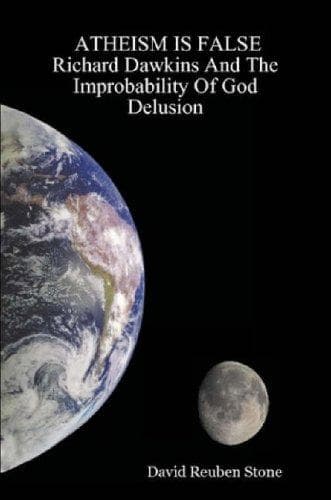
Atheism is False.. Richard Dawkins and the Improbability of God Delusion
الإلحاد باطل.. ريتشارد دوكينز وعدم احتمالية وهم الإله
L'athéisme est faux.. Richard Dawkins et l'improbabilité du délire de Dieu
Atheism, as defended by Richard Dawkins in The God Delusion, rests on philosophical and scientific errors that, once corrected, leave the existence of God more probable than its denial.
Editorial summary
David Reuben Stone's monograph presents a direct philosophical challenge to Richard Dawkins' atheological arguments in "The God Delusion," particularly targeting Dawkins' deployment of probability reasoning against theism. Writing within the Christian analytic tradition, Stone employs rigorous analytical methodology to expose what he considers fundamental flaws in Dawkins' probabilistic case against God's existence.
The work's central contribution lies in its systematic deconstruction of Dawkins' "Ultimate Boeing 747 gambit," which argues that any designing intelligence must be at least as improbable as the complexity it purportedly explains. Stone contends that Dawkins commits a category error by applying probability calculus designed for physical entities to a necessarily existing being. He argues that Dawkins' argument presupposes a univocal concept of complexity that inappropriately conflates divine simplicity with material composition.
Stone advances his critique through three interconnected strategies. First, he challenges Dawkins' burden of proof assumptions, arguing that the New Atheist movement illegitimately shifts epistemic responsibility entirely onto theists while exempting naturalistic frameworks from comparable scrutiny. Second, he rehabilitates design arguments by demonstrating how contemporary fine-tuning evidence resists Dawkins' explanatory reductionism. Stone particularly emphasizes how anthropic coincidences in fundamental physics create probabilistic pressures that favor theistic over naturalistic interpretations.
Third, and most significantly, Stone develops a cumulative case approach that integrates multiple philosophical arguments—cosmological, axiological, and epistemological—to demonstrate that theism provides superior explanatory power compared to Dawkins' naturalistic alternatives. He argues that Dawkins' critique fails because it addresses individual arguments in isolation rather than recognizing their mutually reinforcing character within a comprehensive theistic framework.
The monograph's philosophical significance extends beyond mere apologetics. Stone engages substantively with probability theory, philosophy of science, and modal logic to show how Dawkins' popularization of atheological arguments relies on philosophical naivety rather than genuine intellectual rigor. By exposing the conceptual limitations of Dawkins' probabilistic atheology, Stone contributes to broader debates about the proper application of scientific reasoning to metaphysical questions.
Stone's work represents a sophisticated entry in the post-New Atheist literature, demonstrating how analytic philosophy's tools can be deployed to defend classical theistic commitments. His careful argumentation illustrates why the God debate requires genuine philosophical engagement rather than the rhetorical dismissals that often characterize popular atheist polemics.
Structured analysis
Argument formulations engaged
Related works
Reuben Stone, David (2007). Atheism is False.. Richard Dawkins and the Improbability of God Delusion.
@book{atheism-is-false-richard-dawkins-and-the,
  author    = {Reuben Stone, David},
  title     = {Atheism is False.. Richard Dawkins and the Improbability of God Delusion},
  year      = {2007},
  url       = {https://god-database.com/en/works/atheism-is-false-richard-dawkins-and-the-improbability-of-god-delusion}
}