
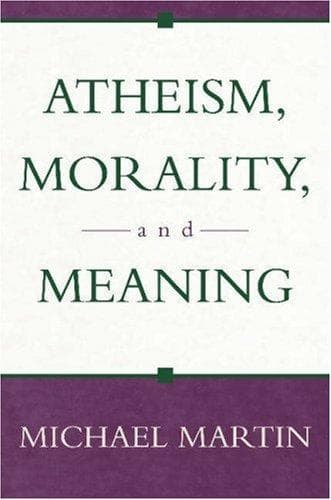
Atheism, Morality, and Meaning
الإلحاد والأخلاق والمعنى
Athéisme, moralité et sens
Editorial summary
Martin's "Atheism, Morality, and Meaning" presents a systematic defense of atheistic ethics against the charge that nonbelief leads inevitably to moral nihilism. Writing in response to theistic philosophers who claim that objective morality requires divine grounding, Martin constructs a comprehensive case for secular moral realism while addressing the existential implications of a godless universe.
The work engages directly with the moral argument for God's existence, particularly as formulated by contemporary Christian apologists. Martin challenges the premise that moral objectivity depends on divine command or divine nature, arguing instead that moral facts can be grounded in naturalistic features of human psychology, social cooperation, and rational deliberation. His approach draws on both analytic moral philosophy and empirical research in evolutionary ethics to demonstrate how moral norms emerge from natural processes without requiring supernatural explanation.
Central to Martin's project is his critique of divine command theory and its variants. He examines classical formulations from medieval theology through contemporary versions offered by Robert Adams and Philip Quinn, identifying logical difficulties in deriving moral obligations from divine will. Martin argues that theistic ethics faces an irresolvable dilemma: either God commands what is good because it is good (making God explanatorily superfluous) or something is good because God commands it (rendering morality arbitrary). His analysis extends beyond this traditional Euthyphro problem to address sophisticated attempts at resolution through divine nature theories.
The monograph's distinctive contribution lies in its positive construction of atheistic meaning. Rather than merely defending atheism against charges of nihilism, Martin develops an account of how life can possess objective value and subjective significance without transcendent purpose. He examines various secular approaches to meaning, from existentialist self-creation to naturalistic theories of human flourishing, ultimately defending a pluralistic view that combines objective and subjective elements.
Martin's methodology reflects the analytic tradition's emphasis on conceptual clarity and logical rigor. His arguments proceed through careful analysis of key terms, systematic evaluation of opposing positions, and construction of counterexamples. This approach enables him to address not only philosophical arguments but also psychological objections about the livability of atheistic worldviews. The work stands as a significant contribution to secular ethics, demonstrating that rejection of theism need not entail rejection of moral objectivity or existential meaning.
Argument formulations engaged
Related works
Martin, Michael (2002). Atheism, Morality, and Meaning. Prometheus Books.
@book{atheism-morality-and-meaning-2002,
  author    = {Martin, Michael},
  title     = {Atheism, Morality, and Meaning},
  year      = {2002},
  publisher = {Prometheus Books},
  url       = {https://god-database.com/en/works/atheism-morality-and-meaning-2002}
}