
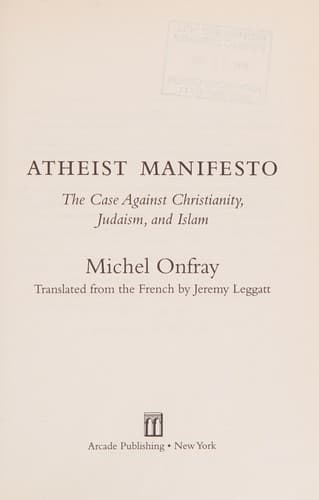
Atheist Manifesto: The Case Against Christianity, Judaism, and Islam
بيان الملحد: القضية ضد المسيحية واليهودية والإسلام
Manifeste athée : L'affaire contre le christianisme, le judaïsme et l'islam
Editorial summary
Herman Philipse's "Atheist Manifesto: The Case Against Christianity, Judaism, and Islam" presents a systematic philosophical critique of the Abrahamic religions, positioning itself as a comprehensive atheistic response to theistic truth claims. The work engages directly with the epistemological foundations of religious belief, examining the rational justifiability of faith in monotheistic traditions.
Philipse structures his analysis around what he terms the "incompatibility thesis" - the claim that religious faith and rational inquiry operate according to fundamentally irreconcilable principles. He argues that the cognitive mechanisms underlying religious belief formation conflict with the standards of evidence and reasoning required for justified belief in other domains of human knowledge. The text devotes considerable attention to deconstructing classical theistic arguments, including cosmological, teleological, and ontological proofs, while also addressing contemporary reformulations of these arguments in analytic philosophy of religion.
The manifesto's methodological approach combines conceptual analysis with empirical considerations drawn from cognitive science and evolutionary psychology. Philipse examines the psychological origins of religious belief, suggesting that evolutionary pressures have produced cognitive biases that predispose humans toward supernatural explanations. He contends that understanding these mechanisms undermines claims about the divine origins or truth of religious experiences.
A significant portion of the work addresses specific doctrinal claims of Christianity, Judaism, and Islam, analyzing concepts such as revelation, prophecy, and scriptural authority. Philipse argues that these religions make empirical claims about historical events and cosmological realities that fail to withstand critical scrutiny. He particularly focuses on the problem of religious diversity, maintaining that the mutual incompatibility of different revelatory claims undermines the credibility of any particular tradition.
The text engages with prominent religious philosophers and theologians, including Richard Swinburne, Alvin Plantinga, and William Lane Craig, offering detailed rebuttals to their arguments for theistic belief. Philipse challenges both evidentalist and reformed epistemological approaches to religious knowledge, arguing that neither provides adequate justification for religious belief.
The work's significance lies in its comprehensive scope and systematic approach to atheistic argumentation. Unlike many popular atheist texts, Philipse's manifesto maintains rigorous philosophical standards while addressing both sophisticated theological arguments and common religious apologetics. His integration of philosophical analysis with empirical findings represents a notable contribution to contemporary debates about the rationality of religious belief.
Argument formulations engaged
Related works
Philipse, Herman (2004). Atheist Manifesto: The Case Against Christianity, Judaism, and Islam.
@book{atheist-manifesto-the-case-against-chris,
  author    = {Philipse, Herman},
  title     = {Atheist Manifesto: The Case Against Christianity, Judaism, and Islam},
  year      = {2004},
  url       = {https://god-database.com/en/works/atheist-manifesto-the-case-against-christianity-judaism-and-islam-2004}
}