
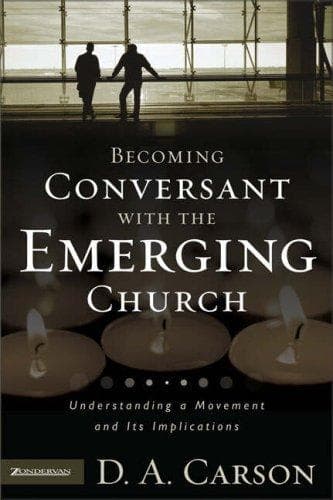
Becoming Conversant with the Emerging Church
أن تصبح متحاوراً مع الكنيسة الناشئة
Devenir familier avec l'Église émergente
Editorial summary
This monograph examines the emerging church movement through a critical theological lens, offering both appreciation and substantial critique of its cultural engagement and doctrinal positions. Carson analyzes the movement's attempt to contextualize Christianity for postmodern culture while raising concerns about its theological trajectory and hermeneutical approaches.
The work begins by mapping the emerging church's self-understanding as a necessary response to cultural shifts from modernity to postmodernity. Carson acknowledges the movement's legitimate concerns about traditionalism, institutionalism, and the church's frequent failure to engage contemporary culture meaningfully. He recognizes their emphasis on authentic community, social justice, and narrative approaches to theology as addressing genuine weaknesses in conventional evangelicalism.
However, Carson's central argument challenges what he perceives as the movement's inadequate grasp of both postmodernism and biblical truth. He contends that emerging church leaders often accept postmodern epistemology too uncritically, particularly regarding claims about the impossibility of objective knowledge and the radical contextuality of all truth claims. This philosophical stance, Carson argues, undermines essential Christian doctrines about God's self-revelation and the accessibility of divine truth through Scripture.
The monograph employs careful textual analysis of key emerging church writings, particularly those of Brian McLaren, to demonstrate what Carson sees as a false dichotomy between absolute and relativistic approaches to truth. He argues that biblical Christianity offers a third way that acknowledges human finitude and cultural conditioning while maintaining that God has spoken truthfully and understandably through Scripture. Carson's critique extends to the movement's handling of biblical authority, suggesting that their hermeneutical innovations often reflect capitulation to cultural pressures rather than faithful contextualization.
Significantly, Carson addresses the emerging church's approach to religious pluralism and the exclusivity of Christ. He argues that their emphasis on humility and dialogue, while valuable, frequently slides into theological compromise regarding salvation through Christ alone. The work demonstrates how questions about epistemology inevitably affect core theological commitments about God's nature, revelation, and salvific purposes.
Carson's methodology combines historical analysis, philosophical critique, and biblical exegesis to evaluate the movement's theological proposals. His work represents a conservative evangelical response that seeks to preserve orthodox commitments about God's knowability and the truthfulness of biblical revelation while acknowledging legitimate criticisms of evangelical cultural captivity. The monograph's enduring contribution lies in its careful delineation of the theological stakes involved in epistemological debates about divine truth.
Argument formulations engaged
Carson, D. A. (2005). Becoming Conversant with the Emerging Church. Zondervan.
@book{becoming-conversant-with-the-emerging-ch,
  author    = {Carson, D. A.},
  title     = {Becoming Conversant with the Emerging Church},
  year      = {2005},
  publisher = {Zondervan},
  url       = {https://god-database.com/en/works/becoming-conversant-with-the-emerging-church-2005}
}