
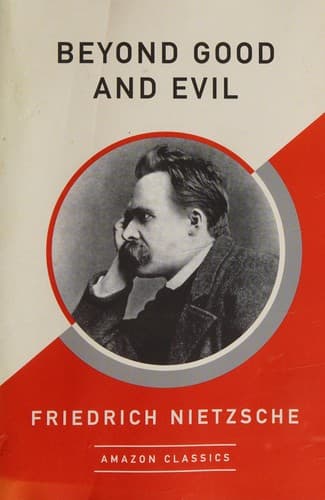
Beyond Good and Evil
ما وراء الخير والشر
Par-delà le bien et le mal
Editorial summary
This philosophical work represents one of Nietzsche's most systematic attacks on traditional metaphysics, morality, and religion, developing his critique of Christianity and theistic belief through an analysis of the psychological and historical origins of moral values. The text advances Nietzsche's thesis that belief in God functions as a symptom of declining vitality and that Western civilization must move beyond such metaphysical constructs to create new values.
Nietzsche employs a genealogical method throughout, tracing religious and moral concepts back to their psychological roots in human weakness, resentment, and the will to power. He argues that the Christian God represents the ultimate expression of slave morality—a projection created by the weak to comfort themselves and to exact imaginary revenge upon the strong. The work systematically dismantles the philosophical foundations that have traditionally supported theistic belief, particularly targeting Plato's metaphysics and Kant's moral philosophy as secular continuations of Christian otherworldliness.
The text's significance for the God debate lies in its psychological rather than purely logical approach to atheism. Rather than engaging in traditional arguments about God's existence, Nietzsche treats belief in God as a cultural and psychological phenomenon to be diagnosed and overcome. He introduces the concept of the "death of God" not as a metaphysical claim but as a historical diagnosis—European civilization has already ceased to genuinely believe, though it clings to Christian moral frameworks without their theological foundation.
Against contemporary philosophers who sought to preserve Christian morality while abandoning Christian metaphysics, Nietzsche insists that rejecting God necessitates a complete revaluation of all values. He criticizes both the English utilitarians and German idealists for their failure to recognize how deeply Christian assumptions permeate their supposedly secular philosophies. The work's aphoristic style serves its philosophical purpose, avoiding systematic argumentation in favor of provocative insights that challenge readers to think beyond conventional categories.
The text's enduring contribution to discussions about God lies in its shift from questions of truth to questions of value and psychological need. By analyzing belief as a symptom rather than addressing it as a proposition, Nietzsche opened new avenues for understanding religion's role in human life. His influence extends through existentialism, postmodern thought, and contemporary debates about secularization, making this work essential for understanding modern atheistic philosophy.
Argument formulations engaged
Related works
Nietzsche, Friedrich (1886). Beyond Good and Evil. AmazonClassics.
@book{beyond-good-and-evil-1886,
  author    = {Nietzsche, Friedrich},
  title     = {Beyond Good and Evil},
  year      = {1886},
  publisher = {AmazonClassics},
  url       = {https://god-database.com/en/works/beyond-good-and-evil-1886}
}