
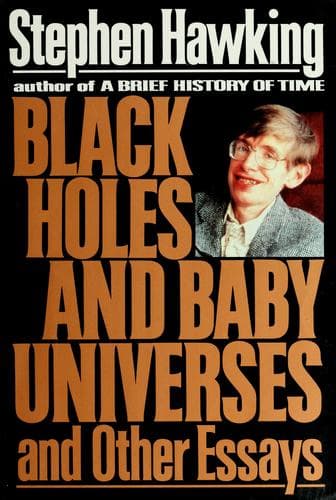
Black Holes and Baby Universes and Other Essays
الثقوب السوداء وأكوان الأطفال ومقالات أخرى
Trous noirs et univers bébés et autres essais
Editorial summary
Stephen Hawking's Black Holes and Baby Universes and Other Essays presents a collection of writings that illuminate his position on fundamental questions about the universe's origin and structure, with significant implications for debates about God's existence. The collection, spanning both technical lectures and popular essays, develops Hawking's naturalistic cosmology while engaging directly with theological questions about creation and design.
The volume's centerpiece essays elaborate Hawking's "no boundary" proposal, which suggests the universe requires no external cause or creator. Building on his earlier work in A Brief History of Time, Hawking argues that quantum mechanics and general relativity together can explain the universe's existence without invoking divine action. He contends that asking what happened before the Big Bang resembles asking what lies north of the North Pole - the question itself contains a category error. This approach directly challenges traditional cosmological arguments for God's existence by removing the need for a first cause.
Hawking addresses the anthropic principle and fine-tuning arguments throughout several essays, proposing that apparent cosmic design might result from selection effects rather than divine intention. His discussion of baby universes and quantum fluctuations suggests mechanisms through which multiple universes could arise naturally, potentially explaining our universe's life-permitting properties without recourse to supernatural design. These arguments engage critically with natural theology while maintaining strict methodological naturalism.
The collection reveals Hawking's philosophical commitments to scientific reductionism and his belief that physics will eventually provide complete explanations for existence. He explicitly discusses religion in several essays, treating religious belief as a human cultural phenomenon while rejecting its explanatory value for understanding physical reality. His tone remains respectful toward religious sentiment while firmly defending the sufficiency of scientific explanation.
Hawking's work contributes to the God debate by demonstrating how contemporary physics challenges traditional metaphysical assumptions about creation, causation, and cosmic purpose. His essays exemplify the conflict model of science-religion interaction, wherein scientific advances progressively eliminate domains previously attributed to divine action. The collection's influence extends beyond physics, shaping popular understanding of how modern cosmology relates to ultimate questions. While Hawking acknowledges the limits of scientific knowledge, he consistently argues that these limits provide no warrant for theological explanations, positioning science as humanity's sole reliable method for understanding reality.
Argument formulations engaged
Hawking, Stephen (1993). Black Holes and Baby Universes and Other Essays. Bantam Books.
@book{black-holes-and-baby-universes-and-other,
  author    = {Hawking, Stephen},
  title     = {Black Holes and Baby Universes and Other Essays},
  year      = {1993},
  publisher = {Bantam Books},
  url       = {https://god-database.com/en/works/black-holes-and-baby-universes-and-other-essays-1993}
}