
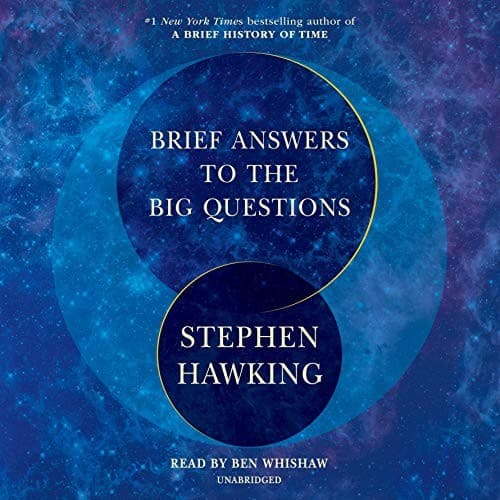
Brief Answers to the Big Questions
إجابات مختصرة على الأسئلة الكبرى
Brèves réponses aux grandes questions
Editorial summary
Stephen Hawking's posthumous Brief Answers to the Big Questions presents his final reflections on humanity's most profound inquiries, including the existence of God. The work synthesizes decades of Hawking's cosmological research and philosophical positions, offering accessible yet scientifically grounded responses to ten fundamental questions. Central to the volume is Hawking's argument against divine necessity in explaining the universe's origin and operation.
The book's opening chapter, "Is There a God?", encapsulates Hawking's naturalistic worldview. Drawing on his expertise in theoretical physics and cosmology, Hawking argues that the laws of physics alone suffice to explain the universe's existence without invoking supernatural agency. He develops this position through his work on the Big Bang, black holes, and quantum mechanics, suggesting that the universe could spontaneously create itself from nothing due to quantum fluctuations. This self-creation hypothesis, rooted in his earlier academic publications, represents his most direct challenge to theistic cosmological arguments.
Hawking's methodology combines scientific empiricism with philosophical naturalism. He explicitly rejects the god-of-the-gaps approach, arguing that attributing unexplained phenomena to divine action represents intellectual capitulation. His stance echoes and extends the tradition of scientific materialism associated with Laplace and later logical positivists, though Hawking's approach remains more accessible to general audiences. He particularly engages with the fine-tuning argument, proposing the multiverse hypothesis as a naturalistic alternative to divine design.
The work's significance extends beyond its specific arguments to its cultural impact. As one of the most prominent scientists of the late twentieth century, Hawking's explicit atheism carries considerable weight in public discourse about science and religion. His arguments directly counter contemporary proponents of intelligent design and theistic evolution, while also challenging more sophisticated philosophical theology that attempts to reconcile modern cosmology with classical theism.
Throughout the text, Hawking maintains that scientific inquiry renders religious explanations obsolete. He advocates for a worldview grounded entirely in empirical investigation and mathematical description, positioning religious belief as a historical artifact rather than a viable contemporary option. This perspective, while not philosophically novel, gains force from Hawking's scientific authority and his ability to communicate complex cosmological concepts to non-specialist readers. The work thus serves as both a summation of Hawking's lifelong scientific materialism and a popular manifesto for atheistic naturalism in the twenty-first century.
Argument formulations engaged
Hawking, Stephen (2018). Brief Answers to the Big Questions. John Murray.
@book{brief-answers-to-the-big-questions-2018,
  author    = {Hawking, Stephen},
  title     = {Brief Answers to the Big Questions},
  year      = {2018},
  publisher = {John Murray},
  url       = {https://god-database.com/en/works/brief-answers-to-the-big-questions-2018}
}