
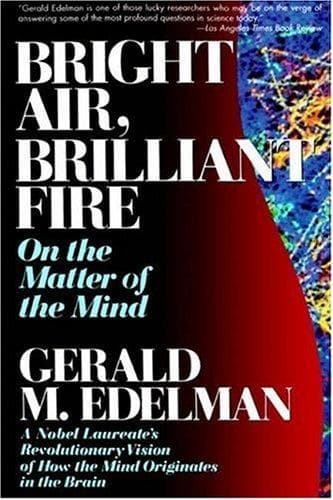
Bright Air, Brilliant Fire: On the Matter of the Mind
هواء صاف ونار لامعة: حول مادة العقل
Air vif, feu brillant : Sur la matière de l'esprit
Editorial summary
Gerald Edelman's "Bright Air, Brilliant Fire" presents a pioneering theory of consciousness that challenges both dualist and reductionist approaches to the mind-body problem. Drawing from his Nobel Prize-winning work on the immune system, Edelman proposes Neural Darwinism, a biological theory of consciousness based on neuronal group selection. His approach fundamentally reconceptualizes how the brain generates conscious experience through competitive selection processes among neural populations rather than through computational algorithms or metaphysical properties.
The work develops a sophisticated naturalistic framework that explains consciousness as an emergent property of complex neural dynamics. Edelman argues that the brain operates not as a computer processing predetermined symbols, but as a selectional system where neuronal groups compete and cooperate to create maps of the world. This Theory of Neuronal Group Selection (TNGS) posits that consciousness arises from reentrant signaling between different brain areas, creating what he terms "the remembered present" - a dynamic integration of memory, perception, and categorization.
Significantly for debates about God and consciousness, Edelman explicitly rejects both substance dualism and the notion that consciousness requires any non-physical explanation. He critiques philosophical positions that invoke divine intervention or irreducible mental properties to explain awareness. His biological theory places consciousness firmly within the natural order, arguing that higher-order consciousness, including religious experience and beliefs about God, emerges from the same selectional processes that generate basic awareness. The work thus provides ammunition for naturalistic philosophers who seek to explain all mental phenomena, including religious cognition, through purely physical processes.
Edelman's contribution extends beyond mere materialism by offering a detailed biological mechanism for how brains generate meaning, values, and even spiritual experiences without recourse to supernatural explanations. He addresses the "explanatory gap" between neural activity and subjective experience by proposing that qualia emerge from the particular history of an individual's neural selections. This historical, embodied approach to consciousness suggests that religious experiences and concepts of the divine are products of neural selection shaped by cultural and individual development.
The monograph's impact on theological discussions lies in its comprehensive naturalistic alternative to dualist accounts of consciousness that have traditionally left room for divine action or spiritual dimensions of mind. By providing a scientifically grounded theory of how brains create meaning and experience, Edelman challenges religious perspectives that depend on consciousness being fundamentally inexplicable through physical processes alone.
Argument formulations engaged
Related works
Edelman, Gerald M. (1992). Bright Air, Brilliant Fire: On the Matter of the Mind. Basic Books.
@book{bright-air-brilliant-fire-on-the-matter-,
  author    = {Edelman, Gerald M.},
  title     = {Bright Air, Brilliant Fire: On the Matter of the Mind},
  year      = {1992},
  publisher = {Basic Books},
  url       = {https://god-database.com/en/works/bright-air-brilliant-fire-on-the-matter-of-the-mind-1992}
}