
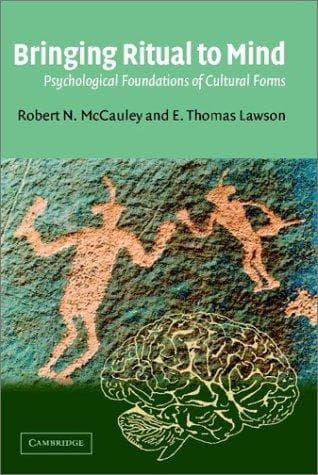
Bringing Ritual to Mind: Psychological Foundations of Cultural Forms
إحضار الطقوس إلى الذهن: الأسس النفسية للأشكال الثقافية
Ramener le rituel à l'esprit : Fondements psychologiques des formes culturelles
Editorial summary
This monograph advances a cognitive science approach to understanding religious ritual, arguing that human minds possess evolved cognitive systems that naturally generate and constrain ritual forms across cultures. McCauley develops this thesis through detailed analysis of ritual competence, demonstrating how universal cognitive mechanisms produce predictable patterns in religious behavior regardless of specific theological content.
The work's central contribution lies in its naturalistic explanation of religious phenomena without reducing them to mere illusion or social construction. McCauley proposes that religious rituals exploit ordinary cognitive systems, particularly those governing action representation, agency detection, and contamination avoidance. This cognitive foundation explains why certain ritual forms recur across disparate cultures and why participants find specific ritual structures intuitively compelling despite lacking explicit theological justification.
McCauley distinguishes between two types of religious rituals based on their frequency and emotional intensity. Special agent rituals, where supernatural beings serve as the primary actors, tend to be performed infrequently but with high sensory pageantry. Special patient rituals, where human participants are the primary actors, occur more frequently with less emotional arousal. This typology emerges from cognitive constraints rather than theological doctrines, suggesting that ritual form follows psychological function rather than religious meaning.
The monograph engages critically with both interpretive approaches in religious studies and earlier cognitive theories of religion. Against hermeneutical traditions that emphasize cultural particularity, McCauley demonstrates cross-cultural regularities that demand psychological explanation. Against crude evolutionary accounts that dismiss religion as adaptive illusion, he shows how religious cognition emerges from the ordinary operation of mental systems that serve multiple functions beyond religion itself.
Methodologically, McCauley synthesizes experimental psychology, cognitive anthropology, and comparative religion to build an empirically grounded theory. His approach exemplifies the broader cognitive science of religion movement, which seeks to explain religious phenomena through the same theoretical frameworks used to understand other aspects of human cognition and behavior.
The implications extend beyond ritual studies to fundamental questions about human nature and religious belief. By showing how cognitive architecture shapes religious expression, McCauley's work suggests that certain forms of religious thinking and practice will persist regardless of cultural changes or scientific advancement. This naturalistic account neither endorses nor refutes theological claims but rather explains why human minds find religious ideas and practices cognitively attractive. The monograph thus provides essential reading for understanding contemporary scientific approaches to religion that avoid both reductionism and relativism.
Argument formulations engaged
Related works
McCauley, Robert N. (2002). Bringing Ritual to Mind: Psychological Foundations of Cultural Forms. Cambridge University Press.
@book{bringing-ritual-to-mind-psychological-fo,
  author    = {McCauley, Robert N.},
  title     = {Bringing Ritual to Mind: Psychological Foundations of Cultural Forms},
  year      = {2002},
  publisher = {Cambridge University Press},
  url       = {https://god-database.com/en/works/bringing-ritual-to-mind-psychological-foundations-of-cultural-forms-2002}
}