
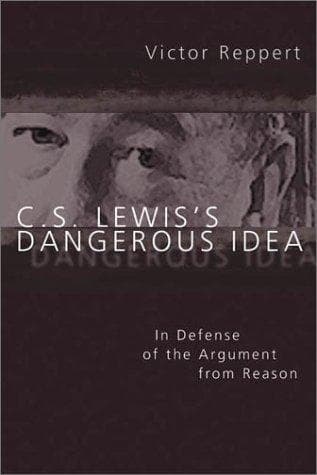
C.S. Lewis's Dangerous Idea
فكرة س. س. لويس الخطيرة
L'idée dangereuse de C.S. Lewis
Editorial summary
Victor Reppert's monograph presents a philosophical defense and elaboration of C.S. Lewis's argument from reason against naturalism, positioning it as a significant challenge to materialist worldviews. The work reconstructs Lewis's contention that naturalism undermines the validity of reasoning itself, thereby creating a self-defeating position for those who reject theistic explanations of consciousness and rationality.
Reppert situates Lewis's argument within broader philosophical debates about the relationship between mind and matter, drawing connections to contemporary philosophy of mind and cognitive science. He demonstrates how Lewis anticipated many current discussions about the "hard problem" of consciousness and the explanatory gap between physical processes and mental phenomena. The author carefully distinguishes Lewis's position from crude god-of-the-gaps reasoning, showing instead how it raises fundamental questions about the preconditions necessary for rational thought.
The monograph engages critically with prominent naturalist philosophers, including Daniel Dennett, Paul Churchland, and Richard Dawkins, examining their attempts to explain consciousness and reasoning through purely physical mechanisms. Reppert argues that these explanations consistently fail to account for the normative dimension of reasoning - the fact that thoughts can be evaluated as true or false, valid or invalid. He contends that naturalism cannot explain how physical states, governed entirely by causal laws, could possess or produce logical relations and intentional content.
Central to Reppert's analysis is the claim that theism provides a more coherent framework for understanding human rationality. He argues that if human minds are created by a rational God, then the reliability of our cognitive faculties and their truth-tracking capabilities become intelligible. The work develops this point through careful philosophical argumentation rather than theological assertion, making it accessible to readers regardless of religious commitment.
The monograph's significance lies in its rigorous philosophical treatment of an argument often dismissed in academic circles. Reppert demonstrates that Lewis's reasoning, while popularized in apologetic contexts, raises serious philosophical questions that naturalists must address. By connecting Lewis's insights to contemporary debates in philosophy of mind, epistemology, and cognitive science, the work shows how theistic arguments remain relevant to current philosophical discussions about consciousness, intentionality, and the foundations of knowledge.
Argument formulations engaged
Related works
Reppert, Victor (2003). C.S. Lewis's Dangerous Idea. IVP Academic.
@book{c-s-lewiss-dangerous-idea-2003,
  author    = {Reppert, Victor},
  title     = {C.S. Lewis's Dangerous Idea},
  year      = {2003},
  publisher = {IVP Academic},
  url       = {https://god-database.com/en/works/c-s-lewiss-dangerous-idea-2003}
}