
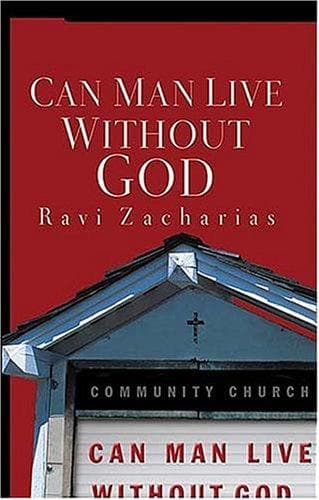
Can Man Live Without God
هل يستطيع الإنسان أن يعيش بدون الله
L'homme peut-il vivre sans Dieu
Editorial summary
Ravi Zacharias's "Can Man Live Without God" presents a comprehensive apologetic response to atheistic worldviews, arguing that human existence without God leads to philosophical incoherence and existential despair. The work systematically examines the logical and practical implications of atheism, contending that rejecting God's existence undermines the foundations for meaning, morality, and hope in human life.
Zacharias structures his argument through both negative critique and positive construction. He engages primarily with the philosophical traditions of Friedrich Nietzsche, Jean-Paul Sartre, and Bertrand Russell, analyzing how their atheistic frameworks fail to provide adequate answers to fundamental human questions about origin, meaning, morality, and destiny. The author employs a combination of philosophical argumentation, literary analysis, and personal anecdote to demonstrate what he perceives as the internal contradictions within atheistic thought. His method draws heavily from the presuppositional apologetic tradition, examining the necessary preconditions for intelligible experience and moral reasoning.
The work's central thesis maintains that atheism, when followed to its logical conclusions, results in nihilism and the dissolution of objective moral values. Zacharias argues that attempts to construct meaning and ethics without transcendent grounding invariably collapse into relativism or arbitrary preference. He particularly critiques secular humanism's effort to preserve human dignity and moral imperatives while denying the theistic foundation that historically supported these concepts. The author contends that only Christian theism provides a coherent worldview that satisfies both intellectual rigor and existential human needs.
Zacharias positions his work within the broader context of late twentieth-century cultural apologetics, responding to the perceived advance of secularization in Western society. His approach combines elements of classical apologetics with contemporary cultural analysis, addressing both academic philosophy and popular atheism. The work engages with postmodern skepticism about religious truth claims while maintaining that absolute truth exists and is knowable through divine revelation.
The significance of this work lies in its accessible yet substantive treatment of complex philosophical issues surrounding God's existence. Zacharias attempts to demonstrate that theistic belief represents not merely a leap of faith but a rational response to the human condition. His critique of atheistic philosophies and defense of Christian theism contributed to evangelical intellectual engagement with secular thought during a period of increasing religious pluralism and skepticism in Western culture.
Argument formulations engaged
Zacharias, Ravi (1994). Can Man Live Without God.
@book{can-man-live-without-god-1994,
  author    = {Zacharias, Ravi},
  title     = {Can Man Live Without God},
  year      = {1994},
  url       = {https://god-database.com/en/works/can-man-live-without-god-1994}
}