
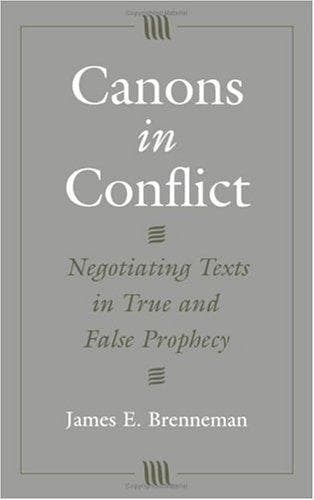
Canons in Conflict.. Negotiating Texts in True and False Prophecy
الأسفار في تعارض.. التفاوض على النصوص في النبوة الصادقة والكاذبة
Des canons en conflit.. La négociation des textes dans la vraie et la fausse prophétie
The distinction between true and false prophecy is not self-evident but is negotiated through competing canonical texts and interpretive communities, revealing the contested nature of prophetic authority.
Editorial summary
Brenneman's monograph examines the complex phenomenon of competing prophetic claims within religious traditions, focusing on how communities negotiate conflicting texts that each claim divine authority. The work investigates the mechanisms by which religious groups distinguish between "true" and "false" prophecy when faced with contradictory messages, both claiming to represent divine will. Through careful textual analysis, Brenneman demonstrates that the process of canon formation involves not merely the preservation of accepted texts but active contestation over which prophetic voices deserve inclusion in authoritative scripture.
The study reveals how religious communities develop interpretive frameworks to manage prophetic conflict, showing that accusations of false prophecy often serve to establish boundaries of orthodox belief. Brenneman traces how certain prophetic texts achieve canonical status while others become marginalized or labeled as heretical, arguing that this process reflects broader power dynamics within religious communities. His analysis spans multiple traditions, examining how Jewish, Christian, and Islamic communities have historically navigated competing prophetic claims, though the emphasis remains on biblical materials and their reception history.
Central to Brenneman's argument is the notion that canonical texts themselves preserve traces of these ancient conflicts, containing both prophecies and counter-prophecies, claims and counterclaims about divine communication. He demonstrates how later interpreters must continuously renegotiate these tensions, showing that the canon does not resolve prophetic conflict but rather institutionalizes it. The work engages particularly with scholars who view canon formation as a straightforward process of collecting authentic divine revelations, arguing instead for a more complex understanding that acknowledges the contested nature of prophetic authority.
The monograph's contribution to discussions about divine revelation lies in its demonstration that claims about God's communication with humanity have always been disputed territory. By focusing on the textual evidence of these disputes, Brenneman illuminates how religious communities construct and maintain their understanding of divine will through ongoing negotiation rather than simple acceptance of prophetic claims. His work suggests that the question of how God speaks to humanity cannot be separated from the social and textual processes by which communities evaluate and authorize such claims. This approach offers valuable insights for contemporary debates about religious authority and the interpretation of sacred texts.
Structured analysis
Structure of the work
Argument formulations engaged
Brenneman, James E. (1997). Canons in Conflict.. Negotiating Texts in True and False Prophecy. Oxford University Press.
@book{canons-in-conflict-negotiating-texts-in-,
  author    = {Brenneman, James E.},
  title     = {Canons in Conflict.. Negotiating Texts in True and False Prophecy},
  year      = {1997},
  publisher = {Oxford University Press},
  url       = {https://god-database.com/en/works/canons-in-conflict-negotiating-texts-in-true-and-false-prophecy}
}