
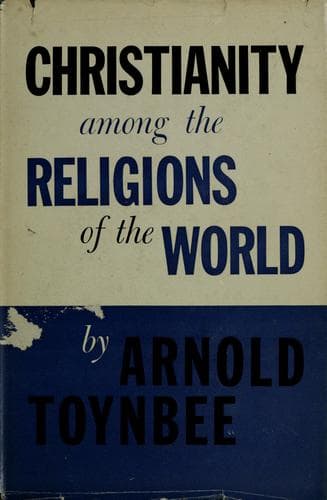
Christianity Among the Religions of the World
المسيحية بين أديان العالم
Le christianisme parmi les religions du monde
Editorial summary
Arnold Toynbee's "Christianity Among the Religions of the World" examines Christianity's place within the broader landscape of world religions through a comparative historical approach. Writing in the aftermath of World War 2 and during the early stages of decolonization, Toynbee challenges Christian exclusivism by arguing that Christianity represents one among several legitimate paths to divine truth rather than the sole avenue to salvation.
The work develops through systematic comparison of Christianity with Buddhism, Hinduism, Islam, and Judaism, analyzing common patterns in religious development and shared ethical foundations. Toynbee employs his characteristic civilizational analysis, treating religions as dynamic historical forces that evolve through cultural encounter and mutual influence. He argues that all higher religions share fundamental insights about the nature of ultimate reality and human spiritual needs, differing primarily in their cultural expressions and historical circumstances rather than in their essential validity.
Central to Toynbee's argument is his critique of Christian claims to absolute uniqueness. He contends that the traditional Christian assertion of exclusive access to divine truth has become both intellectually untenable and morally problematic in an interconnected world. Drawing on his extensive historical research, he demonstrates how religious traditions have consistently borrowed from and influenced one another, making claims of pure originality or exclusive revelation historically naive.
The monograph advances a pluralistic theology that preserves Christian identity while acknowledging the authenticity of other religious paths. Toynbee proposes that Christians can maintain their faith commitment while recognizing that God has revealed truth through multiple religious traditions. This position challenges both conservative Christian theology, which insists on Christianity's exclusive truth claims, and secular perspectives that dismiss all religious claims as equally false.
Toynbee's contribution to debates about God lies in his historically grounded argument for religious pluralism. His work provides intellectual framework for understanding how belief in God can be maintained while rejecting religious exclusivism. The text engages with both Christian triumphalism and secular dismissals of religion, offering a middle path that affirms transcendent reality while embracing religious diversity. His influence extends beyond academic theology to interfaith dialogue and comparative religion, establishing conceptual foundations for non-exclusive theistic belief in a pluralistic world.
Argument formulations engaged
Related works
Toynbee, Arnold (1957). Christianity Among the Religions of the World.
@book{christianity-among-the-religions-of-the-,
  author    = {Toynbee, Arnold},
  title     = {Christianity Among the Religions of the World},
  year      = {1957},
  url       = {https://god-database.com/en/works/christianity-among-the-religions-of-the-world-1957}
}