
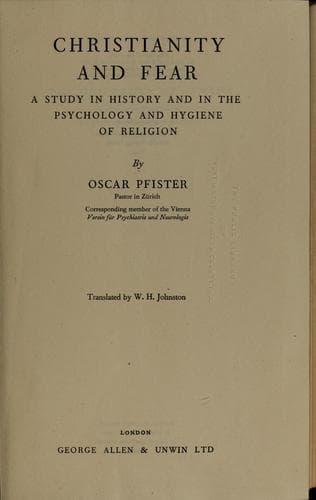
Christianity and Fear
المسيحية والخوف
Christianisme et peur
Editorial summary
This pioneering psychoanalytic study examines the complex relationship between Christian faith and neurotic anxiety, arguing that authentic Christianity should liberate believers from fear rather than cultivate it. Oskar Pfister, a Swiss pastor and psychoanalyst who maintained a decades-long correspondence with Freud, presents a nuanced critique of religious practices that exploit psychological vulnerabilities while defending what he considers genuine Christian spirituality.
The monograph distinguishes between healthy and pathological forms of religious experience, contending that much institutional Christianity has deviated from its founder's teachings by weaponizing fear as a tool of control. Pfister analyzes how certain theological doctrines—particularly those emphasizing divine wrath, eternal damnation, and human depravity—can exacerbate rather than alleviate psychological distress. Drawing on extensive case studies from his pastoral counseling practice, he demonstrates how fear-based religiosity often masks deeper psychological conflicts and contributes to neurotic symptom formation.
Central to Pfister's argument is his reinterpretation of core Christian concepts through a psychoanalytic lens. He maintains that Jesus's message fundamentally concerns psychological liberation and that authentic faith should promote emotional maturity rather than infantile dependence. The work engages critically with both orthodox Christian theology, which Pfister sees as often perpetuating unhealthy fear, and with Freudian psychoanalysis, which he believes too readily dismisses religion's positive potential. Unlike Freud, who viewed religion as inherently neurotic, Pfister argues for a reformed Christianity compatible with psychological health.
The monograph's significance lies in its early attempt to bridge psychoanalysis and progressive theology, prefiguring later developments in pastoral psychology and psychodynamic approaches to religion. Pfister's analysis challenges both religious fundamentalism and reductive psychological interpretations of faith, proposing instead a synthesis that acknowledges religion's capacity for both harm and healing. His work contributes to debates about religious experience's psychological dimensions by offering empirical observations of how different theological frameworks affect mental health.
For the God debate, Pfister's study provides important insights into how beliefs about divine nature shape human psychology. Rather than arguing for or against God's existence, he focuses on the practical consequences of various God-concepts, suggesting that conceptions of deity profoundly influence believers' emotional lives. This psychologically informed approach offers a distinctive perspective on religious phenomena that moves beyond traditional philosophical arguments to examine faith's lived psychological reality.
Argument formulations engaged
Related works
Pfister, Oskar (1948). Christianity and Fear.
@book{christianity-and-fear-1948,
  author    = {Pfister, Oskar},
  title     = {Christianity and Fear},
  year      = {1948},
  url       = {https://god-database.com/en/works/christianity-and-fear-1948}
}