
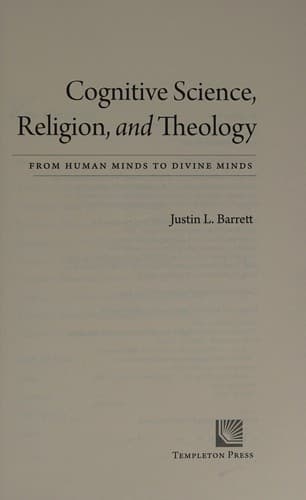
Cognitive Science, Religion, and Theology
العلوم المعرفية والدين واللاهوت
Sciences cognitives, religion et théologie
Editorial summary
This monograph examines the intersection of cognitive science and religious belief, offering a comprehensive introduction to how scientific study of the human mind illuminates religious thought and practice. Barrett, a leading figure in the cognitive science of religion, argues that human cognitive architecture naturally predisposes people toward religious belief, challenging prevailing assumptions that religion represents a deviation from normal reasoning.
The work synthesizes findings from developmental psychology, evolutionary biology, and cognitive anthropology to demonstrate how ordinary mental processes generate religious concepts. Barrett presents evidence that children spontaneously develop beliefs about invisible agents, purpose in nature, and mind-body dualism without explicit instruction. These tendencies, he contends, arise from cognitive systems evolved for other purposes—agency detection, theory of mind, and teleological reasoning—which collectively create a "naturalness" to religious thought.
Central to Barrett's argument is the notion that religious beliefs emerge from normal cognitive functioning rather than pathology or indoctrination. He introduces key theoretical frameworks, including the hyperactive agency detection device (HADD) and minimally counterintuitive concepts, explaining how these mechanisms facilitate the cultural transmission of religious ideas. The analysis extends to examining why certain religious concepts prove more memorable and transmissible than others, drawing on experimental evidence from cross-cultural studies.
Barrett addresses potential theological implications of these findings, arguing against the assumption that natural explanations for religious belief necessarily undermine their truth value. He critiques both reductionist atheistic interpretations and defensive religious responses that reject scientific inquiry. Instead, he advocates for a nuanced understanding that recognizes how cognitive predispositions might serve as divinely intended pathways to religious knowledge, while acknowledging that naturalness does not equate to truth.
The monograph engages critically with prominent atheistic appropriations of cognitive science, particularly those claiming that religion represents a cognitive error or evolutionary byproduct. Barrett demonstrates how the same evidence supports multiple interpretive frameworks, challenging simplistic conclusions about religion's validity based solely on its cognitive foundations.
This work significantly advances dialogue between scientific and religious communities by providing accessible yet rigorous analysis of empirical findings while maintaining openness to their varied philosophical interpretations. It establishes cognitive science of religion as a field relevant to theologians, philosophers, and scientists alike, demonstrating how understanding the mental mechanisms underlying religious belief enriches rather than diminishes discussions about ultimate reality.
Argument formulations engaged
Related works
Barrett, Justin L. (2011). Cognitive Science, Religion, and Theology. Templeton Press.
@book{cognitive-science-religion-and-theology-,
  author    = {Barrett, Justin L.},
  title     = {Cognitive Science, Religion, and Theology},
  year      = {2011},
  publisher = {Templeton Press},
  url       = {https://god-database.com/en/works/cognitive-science-religion-and-theology-2011}
}