
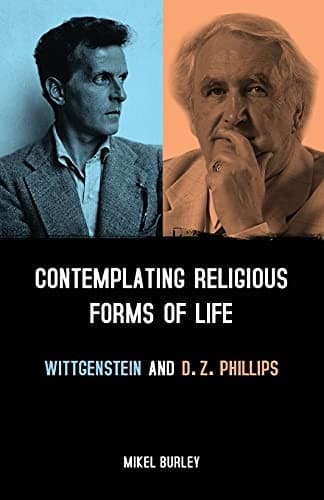
Contemplating Religious Forms of Life
تأمل أشكال الحياة الدينية
Contemplation des formes de vie religieuses
Editorial summary
This monograph examines how contemporary philosophy of religion can benefit from Wittgensteinian approaches to understanding religious belief and practice. Burley argues that much mainstream philosophical discourse about religion, particularly debates concerning God's existence, suffers from conceptual confusion arising from inadequate attention to the diverse ways religious language functions within actual forms of life. Rather than treating religious claims as quasi-scientific hypotheses to be evaluated through abstract argumentation, Burley advocates for a contemplative methodology that seeks to understand religious expressions within their lived contexts.
The work critiques both traditional natural theology and its atheistic opponents for sharing problematic assumptions about the nature of religious belief. When philosophers treat statements about God as empirical claims about a supernatural entity, they misunderstand the grammar of religious discourse. Burley demonstrates how this misunderstanding pervades contemporary debates, from Richard Swinburne's probabilistic arguments for theism to the New Atheists' scientific refutations. Both camps, he contends, fail to recognize that religious utterances often serve expressive, commissive, or transformative functions rather than purely descriptive ones.
Drawing extensively on Wittgenstein's later philosophy, particularly his remarks on religious belief, Burley develops an alternative approach centered on careful description of religious practices and attention to conceptual connections within religious language-games. This methodology involves what he terms "contemplation" - a patient, imaginative engagement with religious forms of life that resists premature judgment or reduction to non-religious categories. The approach bears similarities to anthropological methods but maintains a distinctively philosophical focus on conceptual clarity.
The monograph engages critically with D.Z. Phillips' Wittgensteinian philosophy of religion, acknowledging its insights while arguing that Phillips sometimes imposes overly restrictive limits on legitimate religious expression. Burley also examines how contemplative approaches might illuminate specific religious phenomena, including prayer, ritual, mystical experience, and beliefs about afterlife. Throughout, he emphasizes that understanding religion requires attending to its internal diversity rather than seeking unified theories of religious belief.
The work's significance lies in its systematic challenge to dominant paradigms in philosophy of religion. By shifting focus from questions of truth and justification to questions of meaning and use, Burley opens space for more nuanced philosophical engagement with religious phenomena. His contemplative methodology offers tools for philosophers to discuss religion without reducing it to terms foreign to religious practitioners themselves.
Argument formulations engaged
Burley, Mikel (2012). Contemplating Religious Forms of Life.
@book{contemplating-religious-forms-of-life-20,
  author    = {Burley, Mikel},
  title     = {Contemplating Religious Forms of Life},
  year      = {2012},
  url       = {https://god-database.com/en/works/contemplating-religious-forms-of-life-2012}
}