
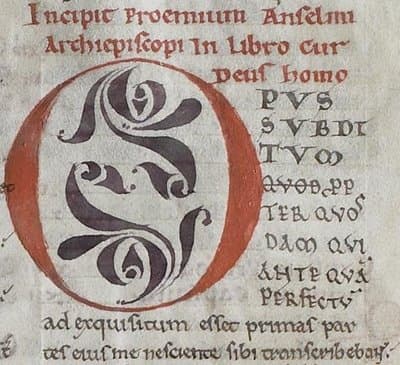
Cur Deus Homo
لماذا صار الله إنساناً
Editorial summary
Anselm of Canterbury's "Cur Deus Homo" represents a pivotal work in medieval theology, offering a systematic rational defense of the Incarnation that fundamentally shaped subsequent Christian thought. Written between 1094 and 1098, this treatise addresses why God became human through a distinctive methodological approach that seeks to demonstrate the necessity of the Incarnation through reason alone, setting aside appeals to scriptural authority.
The work takes the form of a dialogue between Anselm and his student Boso, who voices the objections of both unbelievers and questioning Christians. This dialogical structure allows Anselm to develop his argument progressively while addressing counterarguments. Central to his thesis is the concept of satisfaction: humanity owes God a debt for sin that it cannot pay, while only a being who is both fully divine and fully human could offer adequate recompense. The God-man thus emerges as a logical necessity rather than an arbitrary divine decision.
Anselm's method marks a significant departure from earlier patristic approaches. Where previous theologians primarily marshaled scriptural proofs and allegorical interpretations, Anselm employs what he calls "necessary reasons" (rationes necessariae) to demonstrate that God's incarnation represents the only possible solution to humanity's predicament. This rational approach aims to convince not only Christians but also Jews and Muslims who reject the Incarnation as incompatible with divine dignity.
The work's influence extends far beyond its immediate context. Anselm's satisfaction theory displaced earlier ransom theories of atonement and established a framework that would dominate Western soteriology through Aquinas and the Reformers. His methodology also anticipates later natural theology, demonstrating that reason can illuminate revealed truths without undermining faith's priority.
Critics, particularly from Eastern Orthodox traditions, argue that Anselm's juridical framework imposes human categories onto divine action, potentially limiting God's freedom and mercy. Modern theologians have questioned whether his feudal assumptions about honor and debt remain intelligible. Nevertheless, "Cur Deus Homo" remains foundational for understanding how medieval thinkers reconciled faith and reason, establishing a model of theological argumentation that treats the existence and nature of God as amenable to rational investigation while maintaining divine transcendence.
Argument formulations engaged
Related works
Anselm of Canterbury (1098). Cur Deus Homo. Nabu Press.
@book{cur-deus-homo-1098,
  author    = {Anselm of Canterbury},
  title     = {Cur Deus Homo},
  year      = {1098},
  publisher = {Nabu Press},
  url       = {https://god-database.com/en/works/cur-deus-homo-1098}
}