
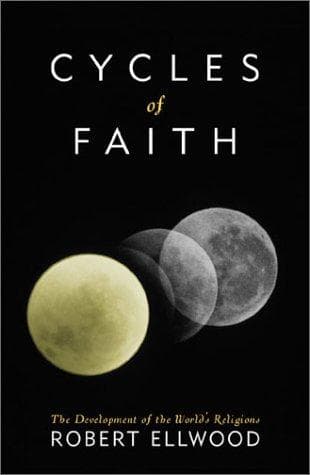
Cycles of Faith.. The development of the world's religions
دورات الإيمان.. تطور أديان العالم
Les Cycles de la foi.. Le développement des religions du monde
The world's major religions follow recurring developmental cycles of origin, growth, institutionalization, and renewal, suggesting that religious life is a universal and structurally patterned dimension of human civilization.
Editorial summary
This monograph presents a comprehensive historical analysis of religious development through the lens of cyclical patterns, examining how major world religions emerge, flourish, and transform over time. Robert Ellwood constructs a theoretical framework that identifies recurring phases in religious evolution, moving beyond linear narratives to propose that religious traditions follow predictable patterns of growth, institutionalization, reform, and renewal.
Central to Ellwood's argument is the concept of "Great Religions" as distinct historical phenomena that share common developmental trajectories despite their theological differences. He traces these patterns across Buddhism, Christianity, Islam, Hinduism, and Judaism, demonstrating how each tradition experiences similar stages: an initial prophetic or revelatory period, followed by rapid expansion, subsequent institutionalization, eventual rigidification, and periodic renewal movements. This cyclical model challenges both progressive accounts of religious evolution and decline narratives common in secularization theory.
The work engages significantly with the broader debate about religion's place in human civilization. Against those who view religious development as either inexorable progress toward enlightenment or inevitable decline toward irrelevance, Ellwood proposes a more nuanced understanding where religions continuously adapt to changing historical circumstances while maintaining core elements. His analysis draws on sociological theories of religious change, particularly those of Max Weber and Joachim Wach, while incorporating insights from comparative religion and historical studies.
Ellwood's methodology combines intellectual history with phenomenological analysis, examining not only the external historical factors shaping religious development but also the internal logic and experiential dimensions that drive religious transformation. He pays particular attention to how religions respond to modernization, globalization, and cultural pluralism, arguing that these challenges often catalyze new cycles of renewal rather than simple decline.
The significance of this work lies in its sophisticated treatment of religious diversity without reducing it to simplistic categories of truth or falsehood. By focusing on patterns and processes rather than theological claims, Ellwood provides a framework for understanding religious change that avoids both religious triumphalism and secular reductionism. His cyclical model offers scholars a valuable analytical tool for examining contemporary religious movements and predicting potential future developments, while remaining neutral on questions of ultimate truth or divine existence.
Structured analysis
Argument formulations engaged
Ellwood, Robert (2003). Cycles of Faith.. The development of the world's religions.
@book{cycles-of-faith-the-development-of-the-w,
  author    = {Ellwood, Robert},
  title     = {Cycles of Faith.. The development of the world's religions},
  year      = {2003},
  url       = {https://god-database.com/en/works/cycles-of-faith-the-development-of-the-worlds-religions}
}