
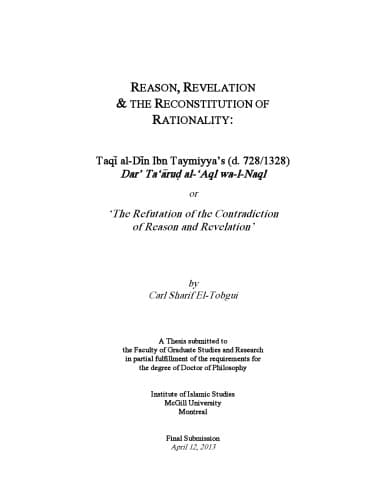
Dar' ta'arud al-'aql wa-l-naql
درء تعارض العقل والنقل
Editorial summary
Ibn Taymiyya's monumental work Dar' ta'arud al-'aql wa-l-naql (Averting the Conflict between Reason and Revelation) represents one of the most systematic medieval Islamic attempts to reconcile rational inquiry with scriptural authority in theological discourse. Written in the early fourteenth century, this treatise directly confronts the epistemological tensions that had emerged within Islamic thought between philosophical rationalism and traditionalist approaches to understanding divine reality.
The work primarily targets the Ash'arite theological school and Islamic philosophers influenced by Aristotelian metaphysics, particularly their claims that certain rational proofs might contradict literal scriptural statements about God. Ibn Taymiyya argues that authentic reason and authentic revelation can never truly conflict, as both originate from the same divine source. When apparent contradictions arise, he contends, the fault lies either in misunderstanding scripture, misapplying reason, or both.
Ibn Taymiyya's method combines rigorous logical analysis with extensive scriptural exegesis. He systematically examines philosophical arguments about divine attributes, particularly those concerning God's relationship to time, space, and creation. Against the philosophers' abstractions, he defends a more anthropomorphic reading of Quranic descriptions of God, though maintaining divine transcendence. His approach rejects ta'wil (metaphorical interpretation) when applied to divine attributes, arguing that such interpretations empty scripture of meaning and elevate human reason above divine revelation.
The work's significance extends beyond its immediate polemical targets. Ibn Taymiyya develops a comprehensive epistemology that privileges revealed knowledge while maintaining a role for reason within defined limits. He argues that reason serves to understand and verify revelation but cannot independently establish metaphysical truths about God's nature. This position challenges both pure rationalism and anti-intellectual traditionalism.
Within the broader God debate, Ibn Taymiyya's treatise exemplifies a distinctly Islamic approach to theological epistemology that differs markedly from contemporary Christian scholasticism or later Enlightenment rationalism. His insistence on the harmony between properly understood reason and revelation provides a sophisticated framework for religious knowledge that continues to influence Islamic theological discourse. The work demonstrates how medieval Islamic thinkers engaged with perennial questions about the limits of human reason in comprehending divine reality, offering a perspective that neither fully embraces nor entirely rejects philosophical theology.
Argument formulations engaged
Related works
Ibn Taymiyya (1317). Dar' ta'arud al-'aql wa-l-naql. McGill University.
@book{dar-taarud-al-aql-wa-l-naql-1317,
  author    = {Ibn Taymiyya},
  title     = {Dar' ta'arud al-'aql wa-l-naql},
  year      = {1317},
  publisher = {McGill University},
  url       = {https://god-database.com/en/works/dar-taarud-al-aql-wa-l-naql-1317}
}