
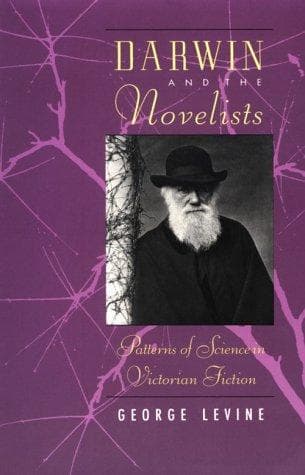
Darwin and the Novelists
داروين والروائيون
Darwin et les romanciers
Editorial summary
George Levine's Darwin and the Novelists examines the profound impact of Charles Darwin's evolutionary theory on Victorian literature and its implications for religious belief. The monograph demonstrates how Darwin's ideas permeated nineteenth-century fiction, fundamentally altering how novelists conceived of human nature, morality, and divine purpose. Levine argues that Darwin's naturalistic worldview created a crisis of meaning that novelists both embraced and resisted, generating new narrative forms while grappling with the loss of providential design.
The work traces how major Victorian authors including George Eliot, Thomas Hardy, and Joseph Conrad internalized Darwinian concepts of chance, variation, and natural selection, incorporating these principles into their fictional worlds. Levine shows how evolutionary theory challenged the traditional novel's reliance on moral order and purposeful plot resolution. Where earlier fiction assumed divine providence guided human affairs, post-Darwinian novels increasingly depicted a universe governed by random forces and material causation. This shift, Levine contends, forced novelists to reconstruct meaning and value without recourse to transcendent authority.
Central to Levine's analysis is the tension between scientific materialism and humanistic values. He demonstrates how Victorian writers struggled to preserve human dignity, free will, and ethical responsibility within a Darwinian framework that reduced humanity to products of blind evolutionary processes. The monograph reveals how novelists developed new literary strategies to address this challenge, creating forms of secular enchantment that maintained aesthetic and moral significance without supernatural foundations.
Levine's methodology combines close literary analysis with intellectual history, situating novels within broader debates about science, religion, and philosophy. He engages with critics who view Darwin's influence as purely destructive to religious faith, arguing instead for a more complex picture where loss of traditional belief generates creative literary responses. The work contributes significantly to understanding how evolutionary theory reshaped not only scientific thought but cultural imagination, showing literature as a crucial site where societies negotiate fundamental changes in worldview.
The monograph's importance lies in its nuanced treatment of secularization as a literary phenomenon. Rather than presenting a simple narrative of faith's decline, Levine reveals how Victorian fiction became a laboratory for exploring what human meaning might look like after Darwin, making it essential reading for scholars interested in the cultural dimensions of the science-religion debate.
Argument formulations engaged
Related works
Levine, George (1988). Darwin and the Novelists.
@book{darwin-and-the-novelists-1988,
  author    = {Levine, George},
  title     = {Darwin and the Novelists},
  year      = {1988},
  url       = {https://god-database.com/en/works/darwin-and-the-novelists-1988}
}