
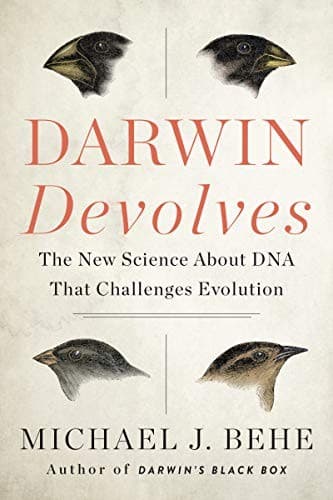
Darwin Devolves: The New Science About DNA That Challenges Evolution
انحطاط داروين: العلم الجديد حول الحمض النووي الذي يتحدى التطور
Darwin dégénère : La nouvelle science de l'ADN qui défie l'évolution
Editorial summary
In Darwin Devolves, biochemist Michael J. Behe extends his critique of evolutionary theory through an examination of recent genetic research, arguing that molecular evidence undermines neo-Darwinian explanations for biological complexity. This work represents Behe's third major intervention in the intelligent design debate, following Darwin's Black Box and The Edge of Evolution.
Behe's central thesis contends that evolutionary processes predominantly work through degradative mechanisms—breaking or damaging genes—rather than constructing novel, complex features. He introduces what he terms the "First Rule of Adaptive Evolution": natural selection tends to "break or blunt any functional genetic element whose loss would increase the number of offspring." Through detailed analysis of experimental evolution studies, particularly Richard Lenski's long-term E. coli experiment and research on polar bear genomics, Behe argues that beneficial mutations typically involve loss of function rather than gain.
The work challenges mainstream evolutionary biology's explanatory sufficiency regarding macroevolutionary transitions and the origin of irreducibly complex systems. Behe particularly targets the adequacy of random mutation and natural selection to generate new protein folds, molecular machines, and integrated biological systems. His argument rests on mathematical improbabilities and what he perceives as empirical limitations in observed evolutionary processes.
Methodologically, Behe employs close readings of peer-reviewed scientific literature, reinterpreting data through his intelligent design framework. He engages directly with critics of his previous works while maintaining his signature biochemical focus. The text operates within the broader intelligent design movement's strategy of presenting scientific arguments for teleology without explicitly identifying the designer.
The book's significance lies in its attempt to marshal recent genomic discoveries as evidence against undirected evolution. Behe positions his argument as scientifically grounded rather than philosophically motivated, though critics note the work's implications clearly favor theistic interpretations of biological origins. His emphasis on devolution rather than evolution represents a tactical shift in intelligent design argumentation, moving from claims about irreducible complexity to assertions about inherent limitations in naturalistic mechanisms.
While Darwin Devolves does not explicitly argue for God's existence, it systematically challenges naturalistic explanations for biological complexity, thereby creating intellectual space for design inferences. The work contributes to ongoing debates about methodological naturalism in science and the relationship between evolutionary theory and religious belief.
Argument formulations engaged
Related works
Behe, Michael J. (2019). Darwin Devolves: The New Science About DNA That Challenges Evolution. HarperOne.
@book{darwin-devolves-the-new-science-about-dn,
  author    = {Behe, Michael J.},
  title     = {Darwin Devolves: The New Science About DNA That Challenges Evolution},
  year      = {2019},
  publisher = {HarperOne},
  url       = {https://god-database.com/en/works/darwin-devolves-the-new-science-about-dna-that-challenges-evolution-2019}
}