
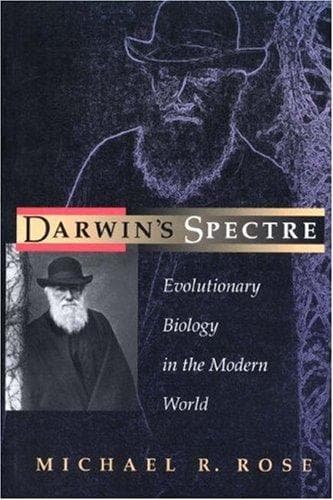
Darwin's Spectre
شبح داروين
Le spectre de Darwin
Darwinian evolutionary theory, far from being confined to biology, casts a long shadow over ethics, society, and human self-understanding, reshaping the questions that any serious worldview must answer.
Editorial summary
This work examines the intellectual legacy of Charles Darwin's evolutionary theory and its implications for religious belief, particularly concerning design arguments for God's existence. Rose explores how Darwinian evolution has shaped contemporary debates about divine purpose in nature, analyzing both the scientific revolution Darwin initiated and the philosophical challenges it poses to traditional theistic worldviews.
The author employs a philosophy of science approach to trace how natural selection offers a naturalistic explanation for biological complexity and apparent design. Rose demonstrates that Darwin's theory fundamentally altered the landscape of natural theology by providing a mechanism through which complex organisms could arise without conscious design or teleological guidance. The work carefully analyzes how this explanatory framework undermines classical design arguments, which had long served as rational supports for theistic belief.
Rose situates Darwin's contribution within the broader trajectory of scientific naturalism, showing how evolutionary theory exemplifies the methodological naturalism that characterizes modern science. The analysis reveals how Darwin's insights extended beyond biology to influence epistemology and metaphysics, challenging not only specific religious doctrines but also fundamental assumptions about purpose and meaning in nature. The author examines how evolutionary thinking reconfigures discussions of apparent design, transforming what once seemed to require divine intelligence into outcomes of undirected natural processes.
The work engages critically with attempts to reconcile evolution with theistic belief, analyzing various strategies religious thinkers have employed to accommodate Darwinian insights while preserving divine action. Rose evaluates these reconciliation efforts, examining their philosophical coherence and scientific credibility. The analysis particularly focuses on how evolution challenges notions of special creation, divine providence, and human uniqueness that feature prominently in traditional theistic thought.
Rose's contribution lies in clarifying the philosophical implications of Darwinian theory for natural theology and design arguments. By examining evolution through the lens of philosophy of science, the work illuminates why Darwin's theory represents more than a biological hypothesis, constituting instead a fundamental challenge to teleological thinking. The analysis helps readers understand how scientific naturalism, exemplified by evolutionary theory, reshapes metaphysical debates about ultimate reality and divine action. This philosophical examination of Darwin's legacy provides valuable insights into why evolution remains contentious in discussions of science and religion, demonstrating how scientific theories can have profound implications for fundamental questions about God, purpose, and cosmic design.
Structured analysis
Structure of the work
Argument formulations engaged
Rose, Michael R. (1998). Darwin's Spectre.
@book{darwins-spectre,
  author    = {Rose, Michael R.},
  title     = {Darwin's Spectre},
  year      = {1998},
  url       = {https://god-database.com/en/works/darwins-spectre}
}