
Editorial summary
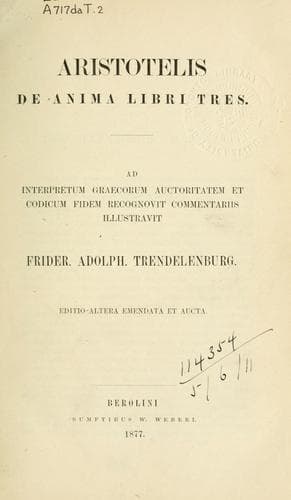
Aristotle's "De Anima" presents a systematic investigation of the soul that fundamentally shapes subsequent theological debates about divine and human nature. Written around 350 BCE, this treatise examines the soul as the organizing principle of living beings, establishing a framework that profoundly influences both Islamic and Christian conceptions of God's relationship to creation.
The work develops a distinctive hylomorphic theory, arguing that soul and body relate as form to matter. Aristotle identifies three types of soul—nutritive, sensitive, and rational—with only the rational soul's active intellect potentially separable from the body. This analysis creates crucial ambiguities about immortality and divine thought that dominate later theological controversies. His treatment of the active intellect, which he describes as separate, unmixed, and eternal, provides a conceptual bridge between human reasoning and divine intelligence.
Against Plato's transcendent Forms and the materialist reductions of earlier natural philosophers, Aristotle grounds his analysis in empirical observation while maintaining the soul's irreducibility to physical processes. His method combines logical analysis with biological investigation, establishing a middle path between pure materialism and radical dualism. The text's famous discussion of thinking thinking itself becomes paradigmatic for understanding divine self-contemplation in medieval theology.
The treatise's theological significance emerges through its influence on subsequent thinkers. Islamic philosophers like Ibn Sina and Ibn Rushd develop elaborate theories about the relationship between human and divine intellect based on Aristotle's cryptic remarks about the active intellect. Christian theologians, particularly Aquinas, adapt Aristotelian psychology to explain the soul's immortality and its capacity for knowing God. The work's naturalistic approach to consciousness paradoxically provides tools for articulating supernatural realities.
Modern debates about consciousness and theism continue to engage with problems Aristotle identifies. His argument that life and mind require formal causes beyond material explanation anticipates contemporary design arguments. Conversely, his naturalistic methodology influences those who seek purely physical explanations for mental phenomena. The text's treatment of final causality in biological and psychological processes remains central to disputes about teleology and divine purpose in nature.
"De Anima" thus occupies a pivotal position in the God debate, offering concepts and arguments that both support and challenge theistic positions, while establishing fundamental categories for discussing the relationship between mind, soul, and ultimate reality.
Argument formulations engaged
Related works
Aristotle (350). De Anima. Oxford University Press.
@book{de-anima-350,
  author    = {Aristotle},
  title     = {De Anima},
  year      = {350},
  publisher = {Oxford University Press},
  url       = {https://god-database.com/en/works/de-anima-350}
}