
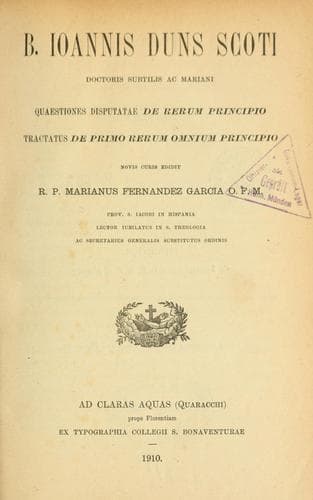
De Primo Principio
في المبدأ الأول
Du premier principe
Editorial summary
Duns Scotus' De Primo Principio stands as one of the most rigorous philosophical demonstrations of God's existence in medieval scholasticism. Written around 1305, this treatise represents Scotus' mature thought on natural theology, offering a highly technical proof that proceeds from the concept of being to establish the existence of an absolutely first principle. The work exemplifies the height of scholastic methodology, combining Aristotelian metaphysics with Augustinian insights while developing distinctively Scotist innovations.
The treatise unfolds through four main chapters that systematically establish different aspects of primacy: efficient causality, final causality, eminence, and the unity of these primacies in a single being. Scotus begins by analyzing the concept of essential order, distinguishing it from accidental sequences to show that any essentially ordered series must terminate in an unqualified first. His argument moves through careful modal distinctions, demonstrating not merely that a first efficient cause exists, but that such a cause exists necessarily. This modal sophistication marks a significant advance over earlier cosmological arguments.
Central to Scotus' approach is his treatment of infinity as God's most fundamental attribute. Unlike Thomas Aquinas, who derives divine infinity from God's pure actuality, Scotus argues that infinity can be proven directly through natural reason. He employs his distinctive formal distinction to show how infinite being contains all perfections eminently while remaining absolutely simple. This emphasis on infinity shapes his entire natural theology and influences his arguments about divine knowledge and will.
The work engages critically with both Aristotelian philosophy and earlier scholastic tradition. While accepting Aristotle's insights about causation and act-potency distinctions, Scotus challenges the Greek philosopher's rejection of actual infinity. Against Henry of Ghent, he defends the possibility of demonstrative knowledge about God. Against Aquinas, he proposes alternative routes to establishing divine attributes, particularly regarding the relationship between intellect and will in God.
De Primo Principio's significance extends beyond its specific arguments to its methodological contributions. Scotus' rigorous conceptual analysis, his attention to logical possibility and necessity, and his development of formal distinctions provide tools that later thinkers would employ in both defending and critiquing natural theology. The work remains influential in contemporary philosophy of religion, particularly in modal versions of cosmological arguments and debates about perfect being theology.
Argument formulations engaged
Related works
Scotus, Duns (1305). De Primo Principio. Marquette Univ Pr.
@book{de-primo-principio-1305,
  author    = {Scotus, Duns},
  title     = {De Primo Principio},
  year      = {1305},
  publisher = {Marquette Univ Pr},
  url       = {https://god-database.com/en/works/de-primo-principio-1305}
}