
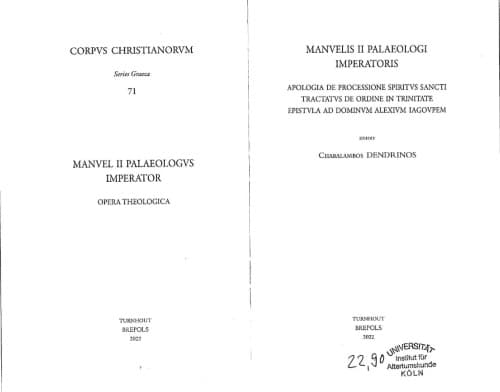
De Processione Spiritus Sancti
انبثاق الروح القدس
Editorial summary
Anselm of Canterbury's De Processione Spiritus Sancti represents a crucial theological intervention in the filioque controversy that divided Eastern and Western Christianity. Written in 1102 following the Council of Bari, this treatise advances a sophisticated defense of the Latin doctrine that the Holy Spirit proceeds from both the Father and the Son, against Greek Orthodox insistence on procession from the Father alone. The work exemplifies Anselm's characteristic method of applying rigorous dialectical reasoning to revealed truths, demonstrating how philosophical argumentation serves theological understanding.
The treatise employs Anselm's distinctive approach of necessary reasons within faith's framework. He argues that the double procession follows necessarily from the unity of divine essence and the relational distinctions between persons. If the Son possesses everything the Father has except paternity, and if the Spirit's procession belongs to the divine essence rather than to personal properties, then the Son must share in the Spirit's procession. Anselm develops this through careful analysis of divine simplicity, showing how the Spirit's procession from both Father and Son preserves rather than threatens divine unity.
Central to Anselm's argument is his examination of relational opposition within the Trinity. He contends that personal distinctions arise only through relations of origin, and that without the filioque, no proper distinction exists between Son and Spirit. This philosophical precision addresses Greek concerns about subordinationism while maintaining Latin theological insights about trinitarian relations. His method combines scriptural exegesis with dialectical necessity, treating biblical passages about the Spirit's relationship to both Father and Son as demanding theological explanation through reason.
The work's significance extends beyond doctrinal controversy to fundamental questions about theological method. Anselm demonstrates how philosophical reasoning operates within faith to clarify divine mysteries without dissolving them. His approach influenced subsequent scholastic theology, particularly in treating the Trinity through precise logical distinctions while maintaining divine simplicity. The treatise also reveals how medieval thought engaged with religious difference through rational argumentation rather than mere authority.
De Processione Spiritus Sancti thus contributes to understanding God through its integration of philosophical rigor with revealed theology. While addressing a specific doctrinal dispute, Anselm advances broader claims about reason's capacity to penetrate divine mysteries when properly oriented by faith. His systematic analysis of trinitarian relations established methodological precedents for scholastic theology's engagement with fundamental questions about God's nature and internal life.
Argument formulations engaged
Anselm of Canterbury (1102). De Processione Spiritus Sancti. Brepols Publishers.
@book{de-processione-spiritus-sancti-1102,
  author    = {Anselm of Canterbury},
  title     = {De Processione Spiritus Sancti},
  year      = {1102},
  publisher = {Brepols Publishers},
  url       = {https://god-database.com/en/works/de-processione-spiritus-sancti-1102}
}