
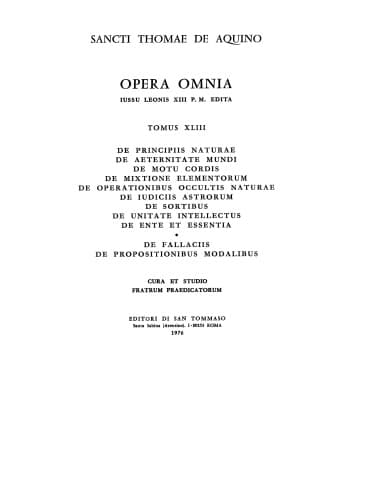
De Unitate Intellectus
في وحدة العقل
De l'unité de l'intellect
Editorial summary
Albert the Great's De Unitate Intellectus represents a pivotal intervention in the thirteenth-century controversy over the nature of the human intellect and its relationship to divine causation. Written around 1270, this treatise directly engages the Averroist interpretation of Aristotle that posits a single, separate intellect for all humanity, a position that threatens both individual immortality and moral responsibility. Albert develops a sophisticated philosophical defense of the individual rational soul that demonstrates how Aristotelian philosophy, properly understood, supports rather than undermines Christian theological commitments about human nature and its relation to God.
The work systematically refutes the notion that there exists only one intellect shared by all human beings, a view Albert associates with Averroes and certain contemporary masters in Paris. Through careful exegesis of Aristotle's De Anima and deployment of philosophical argumentation, Albert establishes that each human being possesses an individual intellectual soul that serves as the form of the body while transcending material conditions in its operations. This position preserves both the unity of human nature and the possibility of personal immortality, crucial elements for understanding humanity's relationship to the divine.
Albert's method combines textual analysis with philosophical demonstration, drawing extensively on Aristotle, Avicenna, and other philosophical authorities while maintaining theological orthodoxy. He argues that the intellect's ability to know universal truths and immaterial realities points to its divine origin and ultimate orientation toward God as the source of all intelligibility. The individual intellect's capacity for abstract thought thus becomes evidence of humanity's unique position in creation as beings made in the image of God.
The treatise's significance extends beyond the immediate controversy to fundamental questions about divine providence and human dignity. By defending the individuality of the rational soul, Albert preserves the meaningfulness of personal moral agency, individual judgment after death, and the human person's direct relationship with God. His arguments influence subsequent debates about intellect and will, contributing to the scholastic synthesis that seeks to harmonize Aristotelian philosophy with revealed theology. The work exemplifies the medieval confidence that rigorous philosophical analysis, when properly conducted, leads not away from but toward affirmation of divine truth and humanity's created purpose.
Argument formulations engaged
Related works
Great, Albert the (1270). De Unitate Intellectus. Vrin.
@book{de-unitate-intellectus-1270,
  author    = {Great, Albert the},
  title     = {De Unitate Intellectus},
  year      = {1270},
  publisher = {Vrin},
  url       = {https://god-database.com/en/works/de-unitate-intellectus-1270}
}